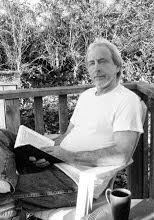
I was out of town last Sunday, so didn't get to put this song up for Halloween. Better never than late? Oh, well. Here it is anyway, and I hope we don't scare you too badly.
Hour of the Banshee
Don’t you hear that banshee
Wailing in the clearing
Someone’s gonna die tonight
The moon’s eye is peering
Don’t it give you gooseflesh
Don’t it bring a frightening
What if we should see her
Naked in the lightning
Let’s go running through the wood wind
Running through the night fen
Running as if haints were gaining on our speed
Flying through the briar
With unnatural power
So we don’t miss the hour of the banshee
Cowards are home cowering
Afraid their name is shrieking borne
But I’m in such a frenzy
To see her whirling in the storm
Come on with me if you dare
We can make it ere the morn
Don’t you want to look and stare
At her diaphanous form
Let’s go running through the wood wind
Running through the night fen
Running as if haints were gaining on our speed
Flying through the briar
With unnatural power
So we don’t miss the hour of the banshee
Let’s go running through the wood wind
Running with mortal grins
Running as if hounds of hell were free
Flying through the swamp mire
Through St. Elmo’s green fire
So we ain’t late for the hour of the banshee
Words & Music by Tim Buck
Sunday, November 7, 2010

Joan of Arcing Sensibility
I've been Facebook friends with Joan Stepp Smith for over a year, maybe. We've had very little interaction. All I have to go by are some photos, comments left here and there, and some stuff on her page. Yet this morning, I'm compelled by forces beyond my comprehension to write something about Joan Stepp Smith.
I like to start writing stuff about which I know very little. It opens up a space for imagination and gives free rein to my wandering mind.
She seems to like the writings of author Kris Saknussemm. That means something to me. She likes the Bergman films Wild Strawberries and Winter Light. That goes deep with me.
So...photos. I see a person who is self-aware and almost completely sane. By "sane," I mean someone who appears to know the world is not sane. It's more like a wild circus, with clowns running everything. While the artists -- those talented hi-wire acrobats -- are left to perform their amazements mostly in the shadows. I think Joan probably owns a pair of magical sunglasses. Ones that, paradoxically, allow her to see the real souls doing special stuff in those shadow regions.
So...comments. I've only come across a few of them, on my page and on other pages. The infrequency of her words lends a special, thoughtful luster to them. No, "luster" is only the afterglow. The immediate sense is one of voltage. Of intense yet contained electricity. Little lightning flashes of intelligence, arcing from her mind via words onto pages.
This is important. It's important for me to nail down that quality of rare utterance. It's almost like a wondrous ghost wafting in unexpectedly and speaking from another world. A world of silence and poise. You pay attention when something unusual is happening.
Maybe part of it has to do with syntax. Perfect, to-the-point sentences. No wasted effort. No burdensome, irksome prolixity. Succinctness. Coiled expression. Thoughtful saying. The core of me quivers when I encounter sophistication and deep intelligence.
Joan's words arc, sending sparks of meaning across the cyber gulf. Especially when she speaks about music.
Oh...and Joan is a poet. She has a collection of poems available here:
IN A PASTURE WITH PALOMINOS
I like to start writing stuff about which I know very little. It opens up a space for imagination and gives free rein to my wandering mind.
She seems to like the writings of author Kris Saknussemm. That means something to me. She likes the Bergman films Wild Strawberries and Winter Light. That goes deep with me.
So...photos. I see a person who is self-aware and almost completely sane. By "sane," I mean someone who appears to know the world is not sane. It's more like a wild circus, with clowns running everything. While the artists -- those talented hi-wire acrobats -- are left to perform their amazements mostly in the shadows. I think Joan probably owns a pair of magical sunglasses. Ones that, paradoxically, allow her to see the real souls doing special stuff in those shadow regions.
So...comments. I've only come across a few of them, on my page and on other pages. The infrequency of her words lends a special, thoughtful luster to them. No, "luster" is only the afterglow. The immediate sense is one of voltage. Of intense yet contained electricity. Little lightning flashes of intelligence, arcing from her mind via words onto pages.
This is important. It's important for me to nail down that quality of rare utterance. It's almost like a wondrous ghost wafting in unexpectedly and speaking from another world. A world of silence and poise. You pay attention when something unusual is happening.
Maybe part of it has to do with syntax. Perfect, to-the-point sentences. No wasted effort. No burdensome, irksome prolixity. Succinctness. Coiled expression. Thoughtful saying. The core of me quivers when I encounter sophistication and deep intelligence.
Joan's words arc, sending sparks of meaning across the cyber gulf. Especially when she speaks about music.
Oh...and Joan is a poet. She has a collection of poems available here:
IN A PASTURE WITH PALOMINOS
Okay!...What is evil? (or Does the Cosmos Resent Itself?)
Is evil a simpler phenomenon that most people think? I shall apply Occam's Razor. I was going to use it to shave with this morning but decided instead to solve a great mystery. First, I want to look at some prevalent theories of evil.
Let's dispense with Yin-Yang right off the bat.
In the morning, a guy is sitting in his garden drinking hot tea. A crazy monkey jumps across his table and, after laughing wildly, scampers off into the bushes. The guy is startled, with the tea ending up in his lap. In the afternoon, the same guy is walking along, with an ice-pack stuck in his pants. A rhinoceros comes flying out of nowhere and rams an apple tree. Apples fall and keep falling, since the frustrated beast's horn is still stuck in the tree trunk. The expression on the guy's face changes, from misery to bliss. He forgets the burning pain in his groin. He scoops up the free apples and is happy. That night, he has an epiphany, so he sharpens a stick and dips it in charcoal dust to write his profound discovery: “This morning, something bad happened. This afternoon, something good happened. That means evil and good are evenly distributed in the world. And that must surely mean that reality itself is half-evil and half-good. Eureka!”
Here's why our spontaneous sage is wrong: he doesn't know it yet, but tomorrow he is gonna suffer 13 separate incidences of bad-monkey behavior and only one rhinoceros donation. He will soon discover that there is far more evil than good in the world.
Okay...on to Judaism.
The founders, prophets, and teachers of Judaism (including Jesus, who was Jewish, not a Christian) brought forth and expounded a religion of ethics. Based on original sin. Based on some stealthy, illicit, non-rhinoceros apple harvesting. Well, that's just preposterous.
Here come the Christians!
First, see above about Judaism. Second, let's look at a more or less original tangent. In trying to solve theodicy, some thinkers like Teilhard de Chardin end up scratching their heads. And finally positing the idea that evil is only the absence of good.
Less original and less sophisticated thinkers see evil as some kind of tough-love session: God lays it on thick so we'll learn how to work our way through it and become better people. Your child suffers and dies from a horrible disease? Well, good! That's God setting you up to move through grief into personal strength and spiritual accomplishment. What's that, you say? What about the dead child? Oh, don't get picky with details! Where was I? Oh, yeah: you would be mistaken to call it evil – it's an implicit good. Or...everything we experience as evil will “someday” be revealed as the working out of a Great Plan.
I don't buy it. That God could easily send us all a mass email, explaining that Great Plan right now.
I'm not sure what the Muslim deal is. I guess whatever makes the desert-god frown is evil.
Then, there is the atheistic form. Evil is what is not suitable. It's all relative, man!
So.........what is evil? And now I shift from flippancy to appropriate morbidness, or at least neutral speechifying. Maybe a dash or two more of the flippant stuff.
I like Schopenhauer. I'm not really sure why. Maybe it's more about style and audacity than substance. But the substance is pretty good, too – the numinous as Will. Whatever is fully real inside or behind reality must be the numinous, the what-in-itself. The phenomenal world is the oozing of metaphysical numinous goo into laws, processes, forms, and beings. Our bodies and minds are the veins through which the numinous fuse drives the fleur du mal. That principle is Will (or force, to be more exact). Everything in us and around us is pieces of will extruded from the Great Will -- an invisible, non-sentient pulse. A kind of haywire desiring.
Seems about right to me. Will as essence. So what general form does it take? I select Envy! Wait!...don't laugh...at least not yet.
Quantum process
Quarks (or Higgs bosons or whatever) resent other particles emerging spontaneously from the vacuum. They desire to get the jump on anyone else even thinking about popping from possibility-space into actuality-space. An incalculable number of possible quantum wills were vying for emergence. To displace any other possible tiny wills. The not-yet environment was teeming with resentment and envy. And lo!...one potential particle just happened to be at the right “place” at the right “time” and POW! All the loser possible particles sulked and pouted. Very envious of the guy who got to be.
phase shift 1
From pure potentiality, that first, arrogant, victorious POW ushered in a world. Big change.
Stellar process
Okay...now we have a cosmos frothing and writhing. We have stuff bouncing around – mass and energy. And every shred of it resents every other shred. Everybody wants the space everybody else has. So...it's one collision after another. Everything smacking around in cosmic territorial warfare.
phase shift 2
Room must be made for all this envious activity. So the universe expands. But gravity is the pulse of Great Envy – everything still tries to get to where everything else is. Gas and stars and nascent galaxies just can't stand the thought that somebody else has a where and a when that they don't have. Sometimes, it gets to be a little much. Nobody wins: massive black holes form and suck the living daylights out of everything. But the Envy is too great and passionate to allow the universe to suck itself out completely. And there's always second-class quarks waiting to pop out if the first guy makes a shambles of it all.
Planetary process
Eventually, matter and stuff form planets. On Earth, all the different chemicals are pissed at one another. It's another mad scramble to be THE chemical. But during the battles, chemicals get mixed into one another. Weird reactions occur. And after a while, things settle into matrices, into fixed patterns. Then, the ocean wants to be where the land is, and the land wants to be where the ocean is. Mutual envy causes massive internal stress. Earthquakes. Tsunamis. Volcanoes exploding. They also explode because the infernal regions resent the airy regions their open space. And out of haughty spite, the airy regions rain on the volcanoes, turning their mad fury into impotent steam and frozen lava. I mentioned weird reactions....
phase shift 3
All of this chemical and tectonic bickering and trespassing leads to a highly unsettled affair on Earth. Again, something has to give. The complexities of sustained planetary envy end up squeezing out even another plane of being – a region of suspense, where forms and processes congeal into pseudo-life.
Organic process
And so a billion years or so go by, while odd things are bootstrapping from pseudo into cellular. Oh, my god! Now the swarm begins! A jillion pieces of molecular will – all puffed up with resentment – go after one another. Big Pac Men gobbling up Little Pac Men. The creatures start growing. And begin growing armaments to usurp new territories. Bell Curves are everywhere. Phase-space humps like a herd of bacterial camels. Predator-Prey. Cannibalism. Parasites. Disease. Symbiosis. Envy every freaking where! Everybody wanting to get some of what the other guy's got.
phase shift 4
Animals got bigger, hungrier, toothier, nastier. Until.....consciousness began oozing from the Envy Sphere.
Mental process
More space-time provided for more events. Sooner or later, apes started actually scheming. They formed raiding parties. To steal chimp-women. To steal fruit trees from weaker chimps. Weapons. Murder. Instinct-will turning into lust-will. Envy, envy, envy. Until proto-human beings hopped out of trees. And they were hopping mad, too! As soon as they hit the ground, they fired up their large brains. How dare the planet just sit there being all natural. We shall dominate it through our rabid will and our desire to be everywhere at once. To convert everything to our egoistic purposes. And to have anything that anyone else has. Plans got more complex. Wars broke out. Crime. All crimes spring from the root of envy. Child torturers envy lost innocence. Then came law and politics. Law is just a referee trying to keep people from tearing each other to bleeding chunks. Politics is the grand arena where wills collide. Liberals envy the wealth of conservatives, the wealth they desire to redistribute. Conservatives envy the last copper penny they can pinch from the poor.
phase shift 5
So...the next transition was a profound one. I have trouble believing in progress, but things got weird. Out of all the eons of envy, which led to human beings, something strange happened: empathy began trickling out. It's like human consciousness is a vast abstract mirror that Being held up to itself. It saw itself for the first time. A huge inaudible sigh was expelled. A gradual ennui settled onto the field of forms and processes. Existence and Life felt sorry for itself. Realized the absurdity of Envy. Niches and pockets of love opened up. Fraternity. Beethoven even wrote a choral movement.
It's been a crazy adventure. And maybe things will completely shift again after another thousand years. Since we possess consciousness, it follows that we will never understand it (that needs some elaboration, but I don't feel like thinking that hard right now). Whatever consciousness is, it seems to have begun a phase-shift toward a possibility of empathy, instead of pure envy. Maybe it's a full-circle thing. Maybe we're closing in on the singularity, when Mind expands into Love. Maybe Love is the original core, the brooding vacuum that had to envy itself into Being. In order to create a way for itself to become tangible reality. Opening up a great story, full of passion and creating the chance for nostalgic Memory.
All right! That's about it. Maybe tomorrow, I'll see if I can figure out why water is wet!
Let's dispense with Yin-Yang right off the bat.
In the morning, a guy is sitting in his garden drinking hot tea. A crazy monkey jumps across his table and, after laughing wildly, scampers off into the bushes. The guy is startled, with the tea ending up in his lap. In the afternoon, the same guy is walking along, with an ice-pack stuck in his pants. A rhinoceros comes flying out of nowhere and rams an apple tree. Apples fall and keep falling, since the frustrated beast's horn is still stuck in the tree trunk. The expression on the guy's face changes, from misery to bliss. He forgets the burning pain in his groin. He scoops up the free apples and is happy. That night, he has an epiphany, so he sharpens a stick and dips it in charcoal dust to write his profound discovery: “This morning, something bad happened. This afternoon, something good happened. That means evil and good are evenly distributed in the world. And that must surely mean that reality itself is half-evil and half-good. Eureka!”
Here's why our spontaneous sage is wrong: he doesn't know it yet, but tomorrow he is gonna suffer 13 separate incidences of bad-monkey behavior and only one rhinoceros donation. He will soon discover that there is far more evil than good in the world.
Okay...on to Judaism.
The founders, prophets, and teachers of Judaism (including Jesus, who was Jewish, not a Christian) brought forth and expounded a religion of ethics. Based on original sin. Based on some stealthy, illicit, non-rhinoceros apple harvesting. Well, that's just preposterous.
Here come the Christians!
First, see above about Judaism. Second, let's look at a more or less original tangent. In trying to solve theodicy, some thinkers like Teilhard de Chardin end up scratching their heads. And finally positing the idea that evil is only the absence of good.
Less original and less sophisticated thinkers see evil as some kind of tough-love session: God lays it on thick so we'll learn how to work our way through it and become better people. Your child suffers and dies from a horrible disease? Well, good! That's God setting you up to move through grief into personal strength and spiritual accomplishment. What's that, you say? What about the dead child? Oh, don't get picky with details! Where was I? Oh, yeah: you would be mistaken to call it evil – it's an implicit good. Or...everything we experience as evil will “someday” be revealed as the working out of a Great Plan.
I don't buy it. That God could easily send us all a mass email, explaining that Great Plan right now.
I'm not sure what the Muslim deal is. I guess whatever makes the desert-god frown is evil.
Then, there is the atheistic form. Evil is what is not suitable. It's all relative, man!
So.........what is evil? And now I shift from flippancy to appropriate morbidness, or at least neutral speechifying. Maybe a dash or two more of the flippant stuff.
I like Schopenhauer. I'm not really sure why. Maybe it's more about style and audacity than substance. But the substance is pretty good, too – the numinous as Will. Whatever is fully real inside or behind reality must be the numinous, the what-in-itself. The phenomenal world is the oozing of metaphysical numinous goo into laws, processes, forms, and beings. Our bodies and minds are the veins through which the numinous fuse drives the fleur du mal. That principle is Will (or force, to be more exact). Everything in us and around us is pieces of will extruded from the Great Will -- an invisible, non-sentient pulse. A kind of haywire desiring.
Seems about right to me. Will as essence. So what general form does it take? I select Envy! Wait!...don't laugh...at least not yet.
Quantum process
Quarks (or Higgs bosons or whatever) resent other particles emerging spontaneously from the vacuum. They desire to get the jump on anyone else even thinking about popping from possibility-space into actuality-space. An incalculable number of possible quantum wills were vying for emergence. To displace any other possible tiny wills. The not-yet environment was teeming with resentment and envy. And lo!...one potential particle just happened to be at the right “place” at the right “time” and POW! All the loser possible particles sulked and pouted. Very envious of the guy who got to be.
phase shift 1
From pure potentiality, that first, arrogant, victorious POW ushered in a world. Big change.
Stellar process
Okay...now we have a cosmos frothing and writhing. We have stuff bouncing around – mass and energy. And every shred of it resents every other shred. Everybody wants the space everybody else has. So...it's one collision after another. Everything smacking around in cosmic territorial warfare.
phase shift 2
Room must be made for all this envious activity. So the universe expands. But gravity is the pulse of Great Envy – everything still tries to get to where everything else is. Gas and stars and nascent galaxies just can't stand the thought that somebody else has a where and a when that they don't have. Sometimes, it gets to be a little much. Nobody wins: massive black holes form and suck the living daylights out of everything. But the Envy is too great and passionate to allow the universe to suck itself out completely. And there's always second-class quarks waiting to pop out if the first guy makes a shambles of it all.
Planetary process
Eventually, matter and stuff form planets. On Earth, all the different chemicals are pissed at one another. It's another mad scramble to be THE chemical. But during the battles, chemicals get mixed into one another. Weird reactions occur. And after a while, things settle into matrices, into fixed patterns. Then, the ocean wants to be where the land is, and the land wants to be where the ocean is. Mutual envy causes massive internal stress. Earthquakes. Tsunamis. Volcanoes exploding. They also explode because the infernal regions resent the airy regions their open space. And out of haughty spite, the airy regions rain on the volcanoes, turning their mad fury into impotent steam and frozen lava. I mentioned weird reactions....
phase shift 3
All of this chemical and tectonic bickering and trespassing leads to a highly unsettled affair on Earth. Again, something has to give. The complexities of sustained planetary envy end up squeezing out even another plane of being – a region of suspense, where forms and processes congeal into pseudo-life.
Organic process
And so a billion years or so go by, while odd things are bootstrapping from pseudo into cellular. Oh, my god! Now the swarm begins! A jillion pieces of molecular will – all puffed up with resentment – go after one another. Big Pac Men gobbling up Little Pac Men. The creatures start growing. And begin growing armaments to usurp new territories. Bell Curves are everywhere. Phase-space humps like a herd of bacterial camels. Predator-Prey. Cannibalism. Parasites. Disease. Symbiosis. Envy every freaking where! Everybody wanting to get some of what the other guy's got.
phase shift 4
Animals got bigger, hungrier, toothier, nastier. Until.....consciousness began oozing from the Envy Sphere.
Mental process
More space-time provided for more events. Sooner or later, apes started actually scheming. They formed raiding parties. To steal chimp-women. To steal fruit trees from weaker chimps. Weapons. Murder. Instinct-will turning into lust-will. Envy, envy, envy. Until proto-human beings hopped out of trees. And they were hopping mad, too! As soon as they hit the ground, they fired up their large brains. How dare the planet just sit there being all natural. We shall dominate it through our rabid will and our desire to be everywhere at once. To convert everything to our egoistic purposes. And to have anything that anyone else has. Plans got more complex. Wars broke out. Crime. All crimes spring from the root of envy. Child torturers envy lost innocence. Then came law and politics. Law is just a referee trying to keep people from tearing each other to bleeding chunks. Politics is the grand arena where wills collide. Liberals envy the wealth of conservatives, the wealth they desire to redistribute. Conservatives envy the last copper penny they can pinch from the poor.
phase shift 5
So...the next transition was a profound one. I have trouble believing in progress, but things got weird. Out of all the eons of envy, which led to human beings, something strange happened: empathy began trickling out. It's like human consciousness is a vast abstract mirror that Being held up to itself. It saw itself for the first time. A huge inaudible sigh was expelled. A gradual ennui settled onto the field of forms and processes. Existence and Life felt sorry for itself. Realized the absurdity of Envy. Niches and pockets of love opened up. Fraternity. Beethoven even wrote a choral movement.
It's been a crazy adventure. And maybe things will completely shift again after another thousand years. Since we possess consciousness, it follows that we will never understand it (that needs some elaboration, but I don't feel like thinking that hard right now). Whatever consciousness is, it seems to have begun a phase-shift toward a possibility of empathy, instead of pure envy. Maybe it's a full-circle thing. Maybe we're closing in on the singularity, when Mind expands into Love. Maybe Love is the original core, the brooding vacuum that had to envy itself into Being. In order to create a way for itself to become tangible reality. Opening up a great story, full of passion and creating the chance for nostalgic Memory.
All right! That's about it. Maybe tomorrow, I'll see if I can figure out why water is wet!
Impression....and a cat!
I'm writing this little thing to distract me from something else.
I arrived, after an eight-hour drive, in Blue Springs, Missouri, on Sunday around 5 PM.
A little later, I drove through the old downtown residential area of this medium-sized city 10 miles east of Kansas City. The sunset light was darkening to twilight. Driving south down 15th Street, I focused on the houses on my right: older, smallish houses.
My impression was not stimulated by any thoughts of evil or good that might be transpiring behind the walls of those houses. It was a vaguer impression, a neutral inspiration for thinking as I drove past.
The sense of things was that those houses exuded an insular, dream-like spirit. Tiny front yards. Neat clutter on front porches. Curtains open, revealing lighted living rooms. No one visible inside. Do people live in those houses? What are they doing inside? What are they thinking about? Or are they more like dream-people, who don't actually ponder and reflect, but who only move around stealthily, performing certain banal-arcane rituals?
In a word, those houses are surreal. Of course, all of life is blended into weirdness. But those houses are a more compact, more concentrated weirdness. You can “see” it vibrating inside – through those windows. In those empty lit living rooms, with the other rooms dark. Insular houses in an old residential area.
Those houses felt like they were built along a tree-lined street on Jupiter. And it's as if reality itself was being held at arm's length. As if cosmic gravity was being repulsed by those exterior walls. Retreats. Caves. Cells where familial pathologies – mild or intense – simmer and slowly froth. Beyond good and evil. Just odd. While the twilight darkens into night. Halloween night. No one on the street. All the ghosts are inside those old smallish houses.
Strange little worlds in America.
* * *
The next morning, I was standing on my mother's deck. A clear cold autumn morning. I was listening to the breeze swish through the tall oak tree, just off the deck. The trunk on this tree is so straight it could be used as a reference plumb.
A beautiful light-gray cat scampered into the backyard. A medium-sized, well-fed cat. Without a moment's hesitation, it bounded up the deck steps, looked at me, and then rolled over on its back. The expression on its face seemed to say: “Hey, Tim....what the fuck are you doing here? Cool, man!”
I bent down and stroked its back and behind its ear. This cat was a happy cat. A social cat. A cool cat.
And did I mention that this cat was a beautiful light-gray cat? Black bands ran around the tail. The eyes were a teeming yellow-gold. What a marvelous critter!
Then!....social graces can wait. A movement out in the middle of the yard. All cat senses on alert. And...zoom! – my new friend was off to investigate. To see what might be out there that could be gobbled up for breakfast. Or just played with.
“Goodbye, Smokey [I'll call that cat 'Smokey']. It was so nice to meet you. Hope I see you around some other time.”
I arrived, after an eight-hour drive, in Blue Springs, Missouri, on Sunday around 5 PM.
A little later, I drove through the old downtown residential area of this medium-sized city 10 miles east of Kansas City. The sunset light was darkening to twilight. Driving south down 15th Street, I focused on the houses on my right: older, smallish houses.
My impression was not stimulated by any thoughts of evil or good that might be transpiring behind the walls of those houses. It was a vaguer impression, a neutral inspiration for thinking as I drove past.
The sense of things was that those houses exuded an insular, dream-like spirit. Tiny front yards. Neat clutter on front porches. Curtains open, revealing lighted living rooms. No one visible inside. Do people live in those houses? What are they doing inside? What are they thinking about? Or are they more like dream-people, who don't actually ponder and reflect, but who only move around stealthily, performing certain banal-arcane rituals?
In a word, those houses are surreal. Of course, all of life is blended into weirdness. But those houses are a more compact, more concentrated weirdness. You can “see” it vibrating inside – through those windows. In those empty lit living rooms, with the other rooms dark. Insular houses in an old residential area.
Those houses felt like they were built along a tree-lined street on Jupiter. And it's as if reality itself was being held at arm's length. As if cosmic gravity was being repulsed by those exterior walls. Retreats. Caves. Cells where familial pathologies – mild or intense – simmer and slowly froth. Beyond good and evil. Just odd. While the twilight darkens into night. Halloween night. No one on the street. All the ghosts are inside those old smallish houses.
Strange little worlds in America.
* * *
The next morning, I was standing on my mother's deck. A clear cold autumn morning. I was listening to the breeze swish through the tall oak tree, just off the deck. The trunk on this tree is so straight it could be used as a reference plumb.
A beautiful light-gray cat scampered into the backyard. A medium-sized, well-fed cat. Without a moment's hesitation, it bounded up the deck steps, looked at me, and then rolled over on its back. The expression on its face seemed to say: “Hey, Tim....what the fuck are you doing here? Cool, man!”
I bent down and stroked its back and behind its ear. This cat was a happy cat. A social cat. A cool cat.
And did I mention that this cat was a beautiful light-gray cat? Black bands ran around the tail. The eyes were a teeming yellow-gold. What a marvelous critter!
Then!....social graces can wait. A movement out in the middle of the yard. All cat senses on alert. And...zoom! – my new friend was off to investigate. To see what might be out there that could be gobbled up for breakfast. Or just played with.
“Goodbye, Smokey [I'll call that cat 'Smokey']. It was so nice to meet you. Hope I see you around some other time.”
a certain blue
Nature offers us many instances of beauty. Some of these encounters impress themselves deeply into memory. Sometimes, nature becomes mixed up with something else, and memory is not only impressed; it is sacralized.
When I was nine or ten years old, the family was on a short vacation trip from El Dorado, Arkansas to Lake Greeson (near Murfreesboro in southwest Arkansas). I had fallen asleep in the backseat of our Olds 98 and was roused from slumber by Daddy's announcement: “There's the lake.”
I raised up and peered out the window. The road was about a hundred feet up from the lake, with tall dark pines plunging steeply down to the water and forming a forested screen. The tree canopy was such that the lake's extent was blocked; only what appeared between those trunks was visible. Censorship always breeds fascination. Yes, between those trunks, I spied that water. I fell into its strange color. I have never seen that shade of blue since then. It was not a bright, pale turquoise, but that's the closest approximation I can offer. It was strikingly different from any bright, pale turquoise one might associate with Key West or the Caribbean or Bermuda...or some South Sea atoll. It was unique.
I'm not convinced it was a purely natural color. I had just awakened from dreams (surely I had...I always dream when asleep), and I was disoriented. I didn't know how we had gotten to the lake, didn't know where it was in relation to my hometown, didn't even know why we had come to the lake – at a certain age or with a certain daydreaming character, family events just materialize and one gets swept up in the unexplained, unprocessed momentum.
Reflecting now on that memory, I do believe something else was mixed into that strangely beautiful lake water glimpsed through pine trees. In those few seconds before the road curved away from the lake, some residual dreamstuff blended into that sun-dazzled water color. It seemed an unearthly hue. Maybe a mystic-plasma-blue, showing itself only once in that magic space between nature and uncertain consciousness.
When I was nine or ten years old, the family was on a short vacation trip from El Dorado, Arkansas to Lake Greeson (near Murfreesboro in southwest Arkansas). I had fallen asleep in the backseat of our Olds 98 and was roused from slumber by Daddy's announcement: “There's the lake.”
I raised up and peered out the window. The road was about a hundred feet up from the lake, with tall dark pines plunging steeply down to the water and forming a forested screen. The tree canopy was such that the lake's extent was blocked; only what appeared between those trunks was visible. Censorship always breeds fascination. Yes, between those trunks, I spied that water. I fell into its strange color. I have never seen that shade of blue since then. It was not a bright, pale turquoise, but that's the closest approximation I can offer. It was strikingly different from any bright, pale turquoise one might associate with Key West or the Caribbean or Bermuda...or some South Sea atoll. It was unique.
I'm not convinced it was a purely natural color. I had just awakened from dreams (surely I had...I always dream when asleep), and I was disoriented. I didn't know how we had gotten to the lake, didn't know where it was in relation to my hometown, didn't even know why we had come to the lake – at a certain age or with a certain daydreaming character, family events just materialize and one gets swept up in the unexplained, unprocessed momentum.
Reflecting now on that memory, I do believe something else was mixed into that strangely beautiful lake water glimpsed through pine trees. In those few seconds before the road curved away from the lake, some residual dreamstuff blended into that sun-dazzled water color. It seemed an unearthly hue. Maybe a mystic-plasma-blue, showing itself only once in that magic space between nature and uncertain consciousness.
Where is she now?
That girl who struck us out?
I was about 12 or 13 and played 2nd base (occasionally SS and RF) on our Little League baseball team. One evening, a game took us out of El Dorado, Arkansas. To a little town ("town" is pushing things) 10 miles dead-East. I can't remember the name of that place, but I remember that game.
I recall warming up beforehand, playing catch with Randy Bourne. He had blond hair, was slim and a year younger than me. Boy, he sure could fling a ball straight at you. My tosses had a 10 to 15% chance of being wild.
Game starts. Lo and behold, the other team brings out a GIRL to pitch. Ha! This is going to be sweet! We're gonna annihilate em.
She was compact and rather attractive. Had short-cropped blond hair. She wasn't wearing a cap.
Our first batter didn't know what hit him. She fired three strikes in a row, and he didn't even think about swinging. He was worried about physical survival.
If my memory isn't too vague or tricky, she struck out nearly every one of us all night long. She never looked cocky out there on the mound, just confident. Simply enjoying what she was doing.
I got three at-bats and, like the others, just went through the paces. I mean, you couldn't even see the damn ball, much less try to hit it.
So...I do wonder where she is now. How her life went. Did she get to play more coed-style ball? Or did she become a great softball pitcher? I hope she had and is still having a wonderful life.
She was just so heroic-looking to me out there on the mound. Whizzing those scorchers past us and right over the plate.
Female people are neat.
[I just remembered the name of that little place: Old Union.]
I was about 12 or 13 and played 2nd base (occasionally SS and RF) on our Little League baseball team. One evening, a game took us out of El Dorado, Arkansas. To a little town ("town" is pushing things) 10 miles dead-East. I can't remember the name of that place, but I remember that game.
I recall warming up beforehand, playing catch with Randy Bourne. He had blond hair, was slim and a year younger than me. Boy, he sure could fling a ball straight at you. My tosses had a 10 to 15% chance of being wild.
Game starts. Lo and behold, the other team brings out a GIRL to pitch. Ha! This is going to be sweet! We're gonna annihilate em.
She was compact and rather attractive. Had short-cropped blond hair. She wasn't wearing a cap.
Our first batter didn't know what hit him. She fired three strikes in a row, and he didn't even think about swinging. He was worried about physical survival.
If my memory isn't too vague or tricky, she struck out nearly every one of us all night long. She never looked cocky out there on the mound, just confident. Simply enjoying what she was doing.
I got three at-bats and, like the others, just went through the paces. I mean, you couldn't even see the damn ball, much less try to hit it.
So...I do wonder where she is now. How her life went. Did she get to play more coed-style ball? Or did she become a great softball pitcher? I hope she had and is still having a wonderful life.
She was just so heroic-looking to me out there on the mound. Whizzing those scorchers past us and right over the plate.
Female people are neat.
[I just remembered the name of that little place: Old Union.]
an open rebuttal
I wish to thank Stacey Mangiaracina for steering me to this article:
The Problem with American Poetry
Instead of writing a protracted, boring summary of the article, I'll just paste some quotes from it here:
● This vital drive for the destruction of the old and the creation of the new is absent.
● ...even our best poetic imaginations don't have what is needed to imagine and invent what's next.
● ...contribute nothing whatsoever to the general progress of the human endeavor.
● ...but that they inhibit the necessary radical imagination for poets to make the new world.
● By teaching us how to spot surprising juxtapositions, how to discover sublimated implications in the juxtapositions, and how to separate the images, poetry provides skills we need to figure out which politicians actually support our beliefs and what products actually meet our needs and wants.
● In general, poetry has the potential to change society. I refuse to ask any less of it.
● Our poets are not tearing down the fetters of our imaginations so we can dream and then create the next American society. Nor are they inventing the lexicon that will define how the next generation of Americans will think, believe, and feel.
Well...this article is something I can sink my sharpened fangs into. It will be fun sucking the juice out of it. Of course, the author will never read my opinion, so no feelings will be hurt. I would not wish to hurt anyone's feelings. So, I'll just do it behind his back.
Did the Romantic poets improve the next generation of society? Did the Modernists? Should our contemporary poets be working toward a betterment of humankind for the future?
Human beings as a whole are now duller and more uncouth than at almost any time in the past. You'd probably have to go back to the Dark Ages to find an appropriate analog. Supposedly, the invention of the book reduced dullness and suppressed uncouthness. But all it did was permit the wholesale broadcast of obtuseness and lack of couth to a vast public arena. There have been rare exceptions -- Thomas Mann wrote The Magic Mountain. Yes, a lot of fancy-pants technical, science-y stuff continues to push back frontiers. Pain killers and air-conditioning are swell things. But are we any more refined or even more interesting than in previous times? I think our perpetual pushing into time is mostly coarse and preposterous. We can see more stars and old light out there in space, while we continue to lie, cheat, and murder with abandon.
People say that Neanderthals were dull and uncouth. And that is why they went extinct. But not us homo sapiens! We have poets. And if our poets will just shape up and do right, we'll keep on doing better than those old shambling failures at culture. But I've always suspected that Neanderthals survived. They are still living in secluded log cabins deep in the jungly woods around south Arkansas (how they got here is anyone's guess). No one knows for sure, but it's possible. They probably congregate in Neanderthal lodges on Friday nights. Serve beet-juice wine, debate the situation in a sophisticated manner, and have poetry readings. Poems that, owing to introspective refinement and collective moodiness, put our best efforts to shame. Not just a few of them. Every Neanderthal writes and reads poetry. My possible Neanderthals are beyond us homo sapiens, as far as having got our consciousnesses progressed. We only think we are an improving specie.
(I'm not sure the above is even relevant, but I just had to work in some Neanderthals.)
So...no, I don't think the collective consciousness is getting notched-up as the zeitgeist skips into tomorrow. And neither is poetry going to un-warp our societal shape.
Here's the deal: poetry is an aesthetic art form, not an instrumental one. Maybe a few Soviet-era poets got the masses revved up and frothing for change. But really, how good were those poems as poems?
Now...earlier in the article, the author mentions some problems with American poetry that I agree with. But not his main theme -- juicing the social ethos with verse. There is no there there. His unbridled romping into original thinking is worse than some of my own attempts.
* * *
Who am I to say what a poem should or should not do? Well, I'm the guy who loves Wordsworth, Keats, Emily Dickinson, Dylan Thomas, and Ezra Pound, that's who. And on rare occasions when writing a poem of my own, I've slipped into a state of consciousness that is far from ordinary.
The only contribution to posterity that a poem might make is a bequeathing of beauty. Not just formal beauty, but also a kind of spiritual beauty. And that latter thing can, on the surface, seem not beautiful at all. It can even appear ugly. It can disconcert. Even some of my darkest, most tragic, and confusing dreams at night leave me with a sense of beautiful misery....or confrontation with a significant and moving psychological work of art. The atmosphere of dreams and some poems is a self-contained world, sufficient-to-itself in aesthetic power and ramification.
Beneath the surface, a good poem reveals or expresses human depths, either focused on self or as a response to nature. A good poem accomplishes that by talent, craft, and severe self-criticism. And the writing of such poems should never be a conscious effort to please posterity. The future is not ours. Right now is where it's at. Right now is when the aesthetic magic happens. Writing as a gesture to propel an avant-garde or to ennoble the next generation is a ridiculous notion. Writing a poem is, for me, an act of existential reconnaissance, not a strategy for some brave new world.
Yes, we want to share our poems. We want to make an impression of some kind. Or at least most of us do, I think. But that does not translate into a poets'-collective for molding society. It's more like "Look what I wrote. I felt something very deeply. I tried my best to put it in words and in rhythm that will communicate to you how I have experienced something." To me, that's it in a nutshell. Anyone who, to the contrary says "Okay, today I'm going to write a poem that will assist in destroying the old world and making a new one" might be someone who needs a long vacation.
I enjoyed the article. It was food for thought. I must confess that it inspired some flashes of condescension in me: the author Josh Cook seems to be (I might be wrong) a very young man, frothing over with idealistic gusto. But that's a good thing.
The Problem with American Poetry
Instead of writing a protracted, boring summary of the article, I'll just paste some quotes from it here:
● This vital drive for the destruction of the old and the creation of the new is absent.
● ...even our best poetic imaginations don't have what is needed to imagine and invent what's next.
● ...contribute nothing whatsoever to the general progress of the human endeavor.
● ...but that they inhibit the necessary radical imagination for poets to make the new world.
● By teaching us how to spot surprising juxtapositions, how to discover sublimated implications in the juxtapositions, and how to separate the images, poetry provides skills we need to figure out which politicians actually support our beliefs and what products actually meet our needs and wants.
● In general, poetry has the potential to change society. I refuse to ask any less of it.
● Our poets are not tearing down the fetters of our imaginations so we can dream and then create the next American society. Nor are they inventing the lexicon that will define how the next generation of Americans will think, believe, and feel.
Well...this article is something I can sink my sharpened fangs into. It will be fun sucking the juice out of it. Of course, the author will never read my opinion, so no feelings will be hurt. I would not wish to hurt anyone's feelings. So, I'll just do it behind his back.
Did the Romantic poets improve the next generation of society? Did the Modernists? Should our contemporary poets be working toward a betterment of humankind for the future?
Human beings as a whole are now duller and more uncouth than at almost any time in the past. You'd probably have to go back to the Dark Ages to find an appropriate analog. Supposedly, the invention of the book reduced dullness and suppressed uncouthness. But all it did was permit the wholesale broadcast of obtuseness and lack of couth to a vast public arena. There have been rare exceptions -- Thomas Mann wrote The Magic Mountain. Yes, a lot of fancy-pants technical, science-y stuff continues to push back frontiers. Pain killers and air-conditioning are swell things. But are we any more refined or even more interesting than in previous times? I think our perpetual pushing into time is mostly coarse and preposterous. We can see more stars and old light out there in space, while we continue to lie, cheat, and murder with abandon.
People say that Neanderthals were dull and uncouth. And that is why they went extinct. But not us homo sapiens! We have poets. And if our poets will just shape up and do right, we'll keep on doing better than those old shambling failures at culture. But I've always suspected that Neanderthals survived. They are still living in secluded log cabins deep in the jungly woods around south Arkansas (how they got here is anyone's guess). No one knows for sure, but it's possible. They probably congregate in Neanderthal lodges on Friday nights. Serve beet-juice wine, debate the situation in a sophisticated manner, and have poetry readings. Poems that, owing to introspective refinement and collective moodiness, put our best efforts to shame. Not just a few of them. Every Neanderthal writes and reads poetry. My possible Neanderthals are beyond us homo sapiens, as far as having got our consciousnesses progressed. We only think we are an improving specie.
(I'm not sure the above is even relevant, but I just had to work in some Neanderthals.)
So...no, I don't think the collective consciousness is getting notched-up as the zeitgeist skips into tomorrow. And neither is poetry going to un-warp our societal shape.
Here's the deal: poetry is an aesthetic art form, not an instrumental one. Maybe a few Soviet-era poets got the masses revved up and frothing for change. But really, how good were those poems as poems?
Now...earlier in the article, the author mentions some problems with American poetry that I agree with. But not his main theme -- juicing the social ethos with verse. There is no there there. His unbridled romping into original thinking is worse than some of my own attempts.
* * *
Who am I to say what a poem should or should not do? Well, I'm the guy who loves Wordsworth, Keats, Emily Dickinson, Dylan Thomas, and Ezra Pound, that's who. And on rare occasions when writing a poem of my own, I've slipped into a state of consciousness that is far from ordinary.
The only contribution to posterity that a poem might make is a bequeathing of beauty. Not just formal beauty, but also a kind of spiritual beauty. And that latter thing can, on the surface, seem not beautiful at all. It can even appear ugly. It can disconcert. Even some of my darkest, most tragic, and confusing dreams at night leave me with a sense of beautiful misery....or confrontation with a significant and moving psychological work of art. The atmosphere of dreams and some poems is a self-contained world, sufficient-to-itself in aesthetic power and ramification.
Beneath the surface, a good poem reveals or expresses human depths, either focused on self or as a response to nature. A good poem accomplishes that by talent, craft, and severe self-criticism. And the writing of such poems should never be a conscious effort to please posterity. The future is not ours. Right now is where it's at. Right now is when the aesthetic magic happens. Writing as a gesture to propel an avant-garde or to ennoble the next generation is a ridiculous notion. Writing a poem is, for me, an act of existential reconnaissance, not a strategy for some brave new world.
Yes, we want to share our poems. We want to make an impression of some kind. Or at least most of us do, I think. But that does not translate into a poets'-collective for molding society. It's more like "Look what I wrote. I felt something very deeply. I tried my best to put it in words and in rhythm that will communicate to you how I have experienced something." To me, that's it in a nutshell. Anyone who, to the contrary says "Okay, today I'm going to write a poem that will assist in destroying the old world and making a new one" might be someone who needs a long vacation.
I enjoyed the article. It was food for thought. I must confess that it inspired some flashes of condescension in me: the author Josh Cook seems to be (I might be wrong) a very young man, frothing over with idealistic gusto. But that's a good thing.
Subscribe to:
Posts (Atom)