Showing posts with label literature. Show all posts

Sunday, March 26, 2017

a meditation on Schubert's WINTERREISE


Franz Schubert died at the age of 31.

When I listen to his works, a condition of reverence permeates my brain -- a spontaneous, natural hallowing of his memory. He conjured music of deathless beauty. His songs are exquisite spells of melancholy.

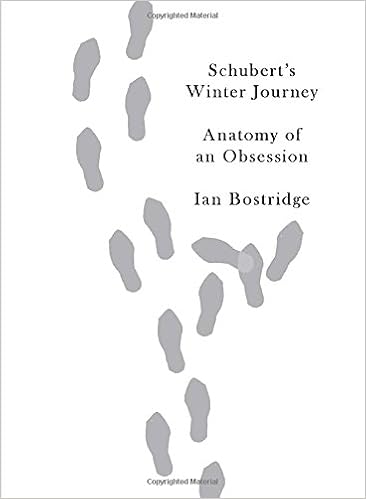
I think this book is a good thing, a well-written and thorough appreciation of the great song cycle Winterreise:


amazon.com


Sunday, February 5, 2017

Coming in April....!


Slight Exaggeration: An Essay
Adam Zagajewski

amazon.com


Saturday, January 28, 2017

Unseen Pages


In the 1760s, a loose association of writers that might or might not have existed was scattered across Germany. From Baden to Bavaria, from the Black Forest to river cities, a diffuse band of eccentrics wrote treatises, stories, poems, and meditations. All of their inspirations had a center of gravity or allusive subtext concerned with the mystery of aesthetics and the eeriness of being. I’ll assume this shadowy group of writers did indeed exist. That way, I’ll be able to continue writing this essay.
The first stirrings of what would become known as German Romanticism were in the air — in the morning fogs drifting above rivers, through forests, around the forms of Gothic architecture.
The Society of Mutual Dreamers met twice a year – on the summer and winter solstices – at an undisclosed location. Karl Gottfried Fenstermacher (I’ll give him that name), who lived in the Black Forest, would bring to these gatherings the petals from a pale flower that grew in the shade of quietly troubled, darkly murmuring trees. During the secret meetings, attendees would partake of a liquid concoction distilled from those pale petals. They would collectively hallucinate into one another’s dreams and nightmares. They were determined, based on questionable hypotheses and principles, to derive or abstract a universal truth. They wished to touch the sleeping fabric of being, to examine its texture.
During these convergences into dreamland, they would compare impressions and mentally sketch stupefied rudiments for later pages. By such a collective oneiric experience, they hoped the sleeping spirit of the world might disclose a solution to the riddle of beauty and melancholy. These esoteric experiments, therefore, had a basis in Ã„sthetik und Weltschmerz, and were energized by the possibility of poetic transcendence. 
How is it that they could all appear in each dream simultaneously? No one knows.
Inspired by these sojourns into metaphysical regions, the members would return to their homes and write about imagination and abyss. They wrote pages that have never been recovered.
Friends, relatives, villagers, and city dwellers, who went about their conventional routines and thought their conventional thoughts, began to notice something odd about those dispersed members of The Society of Mutual Dreamers. At first, it was an aura of distractedness hovering around their personalities. It was as if, when spoken to, those literary eccentrics paid only half attention to what was being said.
Eventually, the situation became more dramatic, or perhaps tragic. The various odd ones began to appear anemic and pale. The collective condition worsened. As they became almost transparent, they were scolded and advised by their unknowing contemporaries to drink more red wine, to build the blood. Soon, none of them was ever seen or heard from again.
They had taken up permanent residence in the atmospheres of old dreams and evocative nightmares. While in those farther precincts, the members of The Society of Mutual Dreamers would convene seminars. They presented their morbidly ecstatic treatises, stories, poems, and meditations based on how it seemed to be in this tangent world. Those written works were very strange and very beautiful and very profound. They have also never been recovered in our waking world. But in the natural time of mornings and the quiet time of evenings, a gist of those unseen pages would occasionally sigh through trees, villages, and cities. How is that possible? No one knows.
One late afternoon, a young man – Georg Philipp Friedrich Freiherr von Hardenberg, also known as Novalis – was strolling through a grove of brooding trees in the Harz Mountains. That same pale flower also grew there. Novalis would kneel to breathe the fragrance of that flower, but it never occurred to him to render the petals into an occult liqueur. Nonetheless, he was now on his way to becoming odd. The wind picked up, and Novalis heard the ghosts of impressions from the lost Society of Mutual Dreamers. He heard and could almost read those lost pages drifting from the realm of great dreaming. About Novalis, Hermann Hesse would later allude to a new poetic dimension, to marvelous and mysterious work.
Some of Novalis’s pages have been seen:

“The more poetic, the more real.”


By Tim Buck
Monday, September 15, 2014

Beckett & Feldman -- NEITHER


Composer Morton Feldman requested from Samuel Beckett an original text as libretto for an opera (or anti-opera, or monodrama). Beckett sent him 87 words in a text titled Neither. The work, for soprano and orchestra, was completed in 1977.


Neither

to and fro in shadow from inner to outer shadow
--
from impenetrable self to impenetrable unself by way of neither
--
as between two lit refuges whose doors once neared gently close, once away turned from gently part again
--
beckoned back and forth and turned away
--
heedless of the way, intent on the one gleam or the other
--
unheard footfalls only sound
--
till at last halt for good, absent for good from self and other
--
then no sound
--
then gently light unfading on that unheeded neither
--
unspeakable home


Sunday, September 14, 2014

about W. G. Sebald


If you'd like, you can click here to listen:

A German Genius in Britain


Tuesday, March 18, 2014

a world event


amazon.com


Harvard University Press has published a new book. When I think about this book, which I haven't read, I get a strange feeling in the literary-philosophical-cultural zone of my consciousness. That sensation is, paradoxically, a becalmed mania, as if I'm riding a dizzy Ferris wheel while puffing on a Turkish hookah. Just knowing this book exists pleases me very much. 

Read about it here:

"Walter Benjamin's Afterlife"


And here's something cool:

http://www.hup.harvard.edu/features/walter-benjamin.html


Saturday, March 15, 2014

Bernard Malamud


Cynthia Ozick reviews Malamud's collections in Library of America:

"Judging the World"

...his aesthetic is instinct with the muted pulse of what used to be called moral seriousness, a notion gone out of fashion in American writing, where too often flippancy is mistaken for irony. Malamud, a virtuoso of darkest irony, refuses the easy conventions of cynicism and its dry detachment. 


Sunday, March 9, 2014

Amos Oz & Natalie Portman


I read that Natalie Portman has written a screen adaptation for Amos Oz's book A Tale of Love and Darkness. I read that she's currently directing and starring in the film, shooting on location in Jerusalem.

I wish Ms. Portman much success with this project. I think the project is in capable hands.

Having said that, I'm ambivalent about this 2014 film. I liked Oz's book a whole lot. When I like a book a whole lot, the book lives vividly in my imagination, and I want it to stay there as a book. So that makes me ambivalent -- a preference to keep the narrative inside my head and a curiosity about how it might be brought to cinematographic life. 

When the film is released, I'm sure I'll watch it. And I'll probably appreciate it as a thing existing in its own right.  


amazon.com


Monday, February 17, 2014

I'm a-gettin' steamed!


Essays these days.

They're so pipsqueak. They lack spirit, imagination, and flair. They're so comfortably cocooned inside a Paris-to-New York milieu of mincing trope, namedropping erudition, and goes-without-saying self-importance.  Also thematic banality -- writing stuff just to be writing stuff. 

A proper essay thinks by the seat of its freakin' pants. It goes somewhere unexpected. It makes your reading brain blink, astounded by paragraphs happening as prose art. 

An essay should vibrate with originality. An audacious essay is, oddly, an act of humility: a willingness to appear somewhat nuts in the compulsion to explore dubious territory by relying on sheer wits.

Thomas De Quincey wrote real essays:

Thomas De Quincey essays


Monday, February 3, 2014

an intellectual on the road


In Dostoevsky's novel The Possessed (variously Demons), you will find the character Stepan Trofimovitch Verkhovensky. He's an older fellow, an intellectual. He lives mostly inside his head, where the ideal, the abstractive, and the theoretical quiver in consciousness. He lives, therefore, just beyond the actual, in a more liquid or gaseous state than the solid. 

In that respect, I see his intellectualism as a kind of artistry. On the impetus of allusive and expansive thinking, he floats toward possible spheres of interpretation. The life of mind has, over time, opened up a tangential space for this critic at large, for this spirit known as Stepan Trofimovitch. A peripheral "geography" is where the artistic abides. But let's not get carried away. He's an intellectual, not an artist per se, even if his musings and one famous work change time into different substance.  

We find Stepan Trofimovitch in the novel during his later years, when he's a chronic free boarder with the aristocratic Vavara Petrovna. In her manor and with dramatic flair, he soliloquizes perceived slights and gesticulates intrinsic egoism. But he's more eccentrically charming than insufferable. Just a fading candle flame from an older era. 

In Part Three of this novel, there is a Chapter 7: "Stepan Trofimovitch's Last Wandering." After a falling out with Vavara Petrovna, he sets out on the road. Dazed, feverish, and crestfallen, he yet proceeds with a misty hopefulness -- a Don Quixote on a not quite firm mission. Here's an excerpt:


The cart reached him; it was a fairly solid peasant cart. The woman was sitting on a tightly stuffed sack and the man on the front of the cart with his legs hanging over towards Stepan Trofimovitch. A red cow was, in fact, shambling behind, tied by the horns to the cart. The man and the woman gazed open-eyed at Stepan Trofimovitch, and Stepan Trofimovitch gazed back at them with equal wonder, but after he had let them pass twenty paces, he got up hurriedly all of a sudden and walked after them. In the proximity of the cart it was natural that he should feel safer, but when he had overtaken it he became oblivious of everything again and sank back into his disconnected thoughts and fancies. He stepped along with no suspicion, of course, that for the two peasants he was at that instant the most mysterious and interesting object that one could meet on the high road.
“What sort may you be, pray, if it's not uncivil to ask?” the woman could not resist asking at last when Stepan Trofimovitch glanced absent-mindedly at her. She was a woman of about seven and twenty, sturdily built, with black eyebrows, rosy cheeks, and a friendly smile on her red lips, between which gleamed white even teeth.
“You . . . you are addressing me?” muttered Stepan Trofimovitch with mournful wonder.
“A merchant, for sure,” the peasant observed confidently. He was a well-grown man of forty with a broad and intelligent face, framed in a reddish beard.
“No, I am not exactly a merchant, I ... I ... moi c'est autre chose.” Stepan Trofimovitch parried the question somehow, and to be on the safe side he dropped back a little from the cart, so that he was walking on a level with the cow.
“Must be a gentleman,” the man decided, hearing words not Russian, and he gave a tug at the horse.
“That's what set us wondering. You are out for a walk seemingly?” the woman asked inquisitively again.
“You . . . you ask me?”
“Foreigners come from other parts sometimes by the train; your boots don't seem to be from hereabouts. . . .”
“They are army boots,” the man put in complacently and significantly.
“No, I am not precisely in the army, I ...”
“What an inquisitive woman!” Stepan Trofimovitch mused with vexation. “And how they stare at me . . . mais enfin. In fact, it's strange that I feel, as it were, conscience-stricken before them, and yet I've done them no harm.”
The woman was whispering to the man.
“If it's no offence, we'd give you a lift if so be it's agreeable.”
Stepan Trofimovitch suddenly roused himself.
“Yes, yes, my friends, I accept it with pleasure, for I'm very tired; but how am I to get in?”
“How wonderful it is,” he thought to himself, “that I've been walking so long beside that cow and it never entered my head to ask them for a lift. This 'real life' has something very original about it.

So much other stuff goes on in this whole novel that someone might ask, "Why are you focusing on this little scene with the two peasants?" It's because I find myself on occasion wondering about the further and farther lives of minor characters.


The two cart peasants are confronted with the riddling presence of an...intellectual! They are also being unconsciously influenced by the intellectual narrator. And behind him, the artistic intellectual author, who has placed those two peasants in an unusual circumstance. They must be feeling ghosts! 

Will they later laugh or whisper about that preposterous stranger on the road? The appearance of Stepan Trofimovitch will surely alter, in the weeks ahead (especially for the woman),  an opinion that things are firmly quotidian. 

The world is odder than it appears. How thoughtful of Dostoevsky to bestow on non-intellectuals an extraordinary encounter with someone from the life of reading and thought. The shock will surely vibrate into their own later years.

And how will brute nature -- rain, snow, wind, stone, stream, wheat -- extruded into the human shapes of two cart peasants affect Stepan Trofimovitch? Will his last dream as he soon lies dying spiral around the weirdness of a contrary mode? Will he sigh out his last toward the enigma of peasants, those who eyed him with suspicion?


Thursday, January 30, 2014

László Krasznahorkai on W.G. Sebald


His novels could be rather not like fiction, and more like a strange diary. Descriptive in some cases: descriptions of stories, states of being. I’ll be in a city, suddenly, in an unknown city, not feeling any sensational effects but some very strange, small effects, and it feels like a book by Sebald: I am unsure, I am uncertain, this uncertainty moves in my soul, it remains there forever. And this is wonderful. It’s not only scary. It’s wonderful too, because the unknown was perhaps the most important element of Max’s [Sebald's] life. The unknown in things. 

László Krasznahorkai


Monday, December 23, 2013

Phantastes


published 1858
George MacDonald


I bought this book in 1978 and have read it several times over the years. When I read it, I'm affected by its dreamy strangeness, its quality of pure fantasy. I like the almost fractal narrative efflorescence.  

I was reminded of this book by a blog post at Flame in the Snow. At the end of that blog post, Novalis is mentioned. A year and a half ago, I posted this about Novalis, mentioning MacDonald as a translator. I also posted this about Novalis's Hymns to the Night.


Thursday, December 19, 2013

Schelling's CLARA


One of the characters in this book says:
Oh, the true ruins are not those of ancient human splendor which the curious seek out in Persian or Indian deserts; the whole Earth is One great ruin, where animals live as ghosts and humans as spirits and where many hidden powers and treasures are locked away, as if by an invisible strength or by a magician's spell.

And this:
Even in your own opinion nature is suffering from a hidden poison that she would like to overcome or reject, but cannot. Doesn't she mourn with us? We are able to complain, but she suffers in silence and can talk to us only through signs and miens. What a quiet wistfulness lies in so many flowers, the mourning dew and in the evening's fading colors.


written in 1811

Sunday, December 15, 2013

an unusual blog


This blog -- Flame in the Snow -- isn't ordinary and boring. It's actually interesting. It's written and compiled by a sensitive soul. From certain depths, a resonance might issue with rich and peculiar coloring. 


Here's a post from there:  

Vertinsky and Pierrot (Blok and Balaganchik)


And I'm honored to be mentioned at flameinthesnow:

Someone is Required


Four exemplary Chekhov aphorisms...


...brought to my attention by Will Crawford:


Life does not agree with philosophy: there is no happiness which is not idleness and only the useless is pleasurable.

The grandfather is given fish to eat, and if it does not poison him and he remains alive, then all the family eat it.

A writer of no talent, who has been writing for a long time, with his air of importance reminds one of a high priest.

Women deprived of the company of men pine, men deprived of the company of women become stupid.


Wednesday, December 11, 2013

Nikolai Leskov


An article in The Irish Times:

1831 - 1895

I once wrote a commentary on Walter Benjamin's commentary on Leskov's storytelling. I don't remember where it is. 

I do remember that I thought my commentary was possibly profound and somehow knowledgeable, even though I'd never read Leskov. How silly! Or maybe how lax and remiss it was of me not to have sought mental treatment for my peculiar condition of reckless graphomania.


The Enchanted Wanderer & Other Stories
amazon.com


to be but not to be pretentious


Whether in one's poems, stories, daily lived attitude, or chronic consciousness, I suggest it might be a good thing to not mythologize oneself.

Even worse is when self-mythologizing takes the form of an artificial role lifted from another's persona. One Hemingway and one Kerouac are adequate as single-occurrence beings. They were already rather shallow and boring. There's no need for any literary and attitudinal redundancy of those types.

Clipped expression and beatnik style go stale very fast. The elemental and the experimental -- masculinity and radicalism per se -- are metaphysically anemic constructions, therefore more cardboard texture than living gesture.

One should aspire to be oneself. And that means scraping off encrustations of pseudo-selves, means not glorifying the banality of your situation, means acquiring a pair of mystical binoculars to spy the question behind formal, fabricated personality.

The Real is vaster and stranger than what goes on in the blinkered coordinates of modern mythy guys.


Thursday, November 28, 2013

Lauren Benjamin thinking Bruno Shulz


Lauren A. Benjamin is not abstract, wayward, or stuffy. She ponders Schulz boldly and sympathetically. Ms. Benjamin appears to know just what it is that is going on in the shadows, silences, and uproariously melancholic situations of Schulz's marvelous book The Street of Crocodiles.

"The Likeness of a Tailor’s Dummy: Bruno Schulz’s Recreation of the Human in Sklepy Cynamonowe"


Tuesday, November 26, 2013

the Sebald Effect


The books of W.G. Sebald can be read over and over and not lose their power to enchant the reader. How is that possible? How do his understated, sustained spells of melancholy call to the reader again and again? I wonder what principle is at work here, what eccentric dynamics are active to energize and re-energize these works.

I almost catch myself hypothesizing that Sebald -- via instinct or insight -- was attuned to the world's deep exhaustion from implausible manifesting, to its difficult dreamlike moods within form, substance, and lingering.