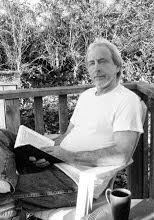
Some of you are mutual friends. I would like to introduce my friend Robyn to others.
I'm a fan of consciousness in human beings. By that, I mean a particular manifestation: those with a large and resilient field of vision. So many operate on direct-current. I prefer alternating-current. I like Nikola Tesla. I like minds that loop and curve. That are like magic mirrors not merely reflecting but somehow also absorbing. Minds that are like Krishna's – knowing, smiling, slippery. Minds one can rely on to always be unexpected.
Every morning and every night, Robyn shines through with good spirits. A cycle of salutation and closing that is warm, genuine, and exuding an atmosphere of hope. She's one of those people who make you think: “Yep, were all headed for pitch-black doom or at least a highly murky unknown, but it's reassuring to know we're not isolated in our peculiar abysses. As weak as we all are against the enormity of being, how pleasant to be in the winking company of this elliptical woman who keeps filling my glass with red wine!”
And serving dreamy dishes the mere cyber descriptions of which are mouth-watering. A way of being in the world at once elegant and down-home. Cosmopolitan and provincial.
Robyn likes art. Weird freaking art. Surrealism (and other stuff, too). She also likes Camus. And Dada.
I mentioned that magic-mirror-absorbing thing. Her consciousness also has something of the fun-house mirror to it. Like how her mind bends and warps and quivers, depending on what enters it from outside and what is projected from strange realms within. She is even – can you believe it? – able to track my own consciousness to a high degree. That pleases me.
Oh...she also knows languages that haven't been invented yet.
Robyn is mutable, flexible. If you say something stupid, she is gracious toward you. Patient, forbearing. If you say something mean or way-stupid...well...be prepared for a subtle, sardonic riposte. The change can occur quickly, throwing you off-balance. You thought you were dealing with a soft-shaded daffodil, but suddenly the petals might turn into honed blades of human truth.
Robyn is genuinely far-out. Like those pioneers of hyper-consciousness back in the sixties. But she's not strictly mental, abstract, and psychedelic. She's also warm and charming. Unique.
Here's a song for you, Robyn:
Strange Overtones
Sunday, November 7, 2010

my weird hometown (a re-post)
I was born in El Dorado, Arkansas, way back in '52. My brother and I always felt that our town was odd. Had a sort of uncanniness to it. And some odd people (heh) grew up there. Things seemed colored with melodramatic shades. Like that hysterical, screaming night woman, pounding on our front door -- an unhinged oracle speaking of sudden death on the highway just now...and implicitly forecasting metaphysical doom to come. There were nightly drum beats in the pinewoods and viney jungle distance, giving me and my brother chronic, delicious frights. There was that creature -- half-pig, half-man -- that would occasionally appear at our bedroom window and peer silently. Ghosts came and went; it was problematic being left alone in the house. One night, very loud thumping -- no, more like a linebacker bouncing off the rafters -- in the attic prompted Dad to call the sheriff. He and a deputy showed up but were too afraid to climb up there to check it out. So Dad went up, while the law looked on from below. He found nothing at all up there.
Maybe kids are unusual everywhere, but back then, our friends and acquaintances certainly seemed so. Not anything overt; just an extra, inscrutable sheen. The strangest thing about them -- and adults -- was the fact that they felt entitled to exist. No qualms whatsoever about being real. They obviously never gave it a second thought. When I think back on my very-young to medium-young days, I see that kid who was in almost constant perplexity. Sitting in the monstrous, tank-like Olds 98, while my mother drove through various sections of town, I was saturated with so many fantastical impressions. Every street, every neighborhood glowed with a kind of mystical weirdness. Especially that half-hidden black part of town. Like it was somehow organically disconnected from the rest of El Dorado. Like it was built up on ground imported from another dimension. I think the word is "incommensurable." Just didn't physically or metaphysically compute in the algorithm of our town's normality. Later, I realized that was attributable to the shameful apartheid so prevalent in the South. But for a while back then...when I was a child soaking up all forms of weirdness...the emphatic difference of the black neighborhood seemed almost enchanting, magical. Sort of like turning down a supposedly familiar street and coming face-to-face with a Medieval village. The dilapidation and make-shiftness of those poor homes appeared charming to my little brain...a colorful, crazy-quilt architecture.
Hernando De Soto came through what was later to be Union County (very south Arkansas). Those Spainiards were a grim, determined lot. What in the world were they doing, traipsing through our godforsaken neck of the woods? Ticks, chiggers, snakes, disease, nonplussed, suspicious natives. Guess it was just something to do back then. Europe must have been awfully boring or just too banal. Popes being courted like blushing, wrinkled maidens by one royal nest of rats after another.
In the early 19th century, a trapper stopped in these environs and set up a trading post. From that beginning, a village sprouted and later the town of El Dorado. Toward the end of that century, the town had become a sort of chic cultural center, at least more chic than Smackover and other outliers. It's hard for me to imagine my town as having been such. It always struck me as uncouth and, well, unimaginative. Then in the early new century, a wild shoot-out -- an undignified duel -- took place in front of the court house in the center of town. Must have been quite a dust-up and something to talk about for a long time.
In the early '20s Busey's well came in, and El Do became an overnight oil boom town. Speculators poured in, as well as hordes of workers for the burgeoning oil fields. Here tell, the town was like a latter-day Dodge City. Wild and woolly. Those days must have doused El Dorado's vaunted cultural fire. As the decades tumbled by, oil refineries were built, and my father was a plant manager at Amoco. Before they built the separate managers' building up on the hill, Mother and I would pick him up in the late afternoon down at the main refinery entrance gate. I still remember being dazzled and frightened by the roaring flames and clouds of steam. And, especially, the psychologically disturbing maze of pipes twisting and running off into unknowable dimensions. Looking back, the whole place was like a vast greedy god -- as if the black blood of unseen sacrificial victims was running through those pipes and being refined into unspeakable elixirs.
Growing up in the early '60s was sort of neat. All the clothing stores and banks surrounding the town square seemed more than houses of commerce. They seemed like environs ripped from my young night dreams and plopped down, helter-skelter, in front of the sidewalks. Charming brass spittoons were everywhere, and cigar smoke saturated every establishment. The merchants had an unusual air about them. It was like existence itself was equatable with their occupations. Not as if working was something to be endured to survive; rather, it was their entire reason for being. One couldn't imagine any of them actually having a separate home life. Surely, they lived every moment of their lives in their houses of business. Yes, strange. Even as a child, I felt alienated from this attitude of allowing one's soul, consciousness, or identity to disappear into any activity.
Howard's Newsstand! For my brother and me, it was a house of dreams. And the proprietor, Howard, was our grizzled, morose priest, granting us access to visions of heaven on earth: that full back wall of comic books (or "funnybooks," as we called them). Every Saturday, we'd be driven with our quarters to Howard's. We would stare, stunned each time before that wall of mesmerizing color and beckoning adventure. I'm serious: it always took us a few moments to come to senses whip-lashed by amazement. Then came the delicious agony of trying to choose from among the hundreds of titles. You could only afford five or six, when twenty or thirty were screaming and pleading at you. You know...actually buying and reading them was probably just an after thought. The main thing about funnybook day was just standing there in adolescent bewilderment and awe.
Junior high was traumatic. If you were from the rich side of town, you went to one school. Not so rich, like us, you attended hell on earth: Roger's Junior High School. The main building was three or four stories and had been built waaay back in history. Besides looking haunted and ferocious, it seemed as if it would come falling down like a House of Usher on us young teens. All the toughs went there. Bloody, vicious fist-fights were daily distractions. The teachers were weird. It was less a school than a survival course. In fact, could it be reconstructed, I would recommend it for a Green Beret training facility. The cafeteria food alone was an existential challenge. I bet those kids across town were being served French cuisine on silver platters.
Memories! Oh, my gosh. Please fly from me! 8th-grade science class...I sat a few seats behind Linda Harris. She was no ordinary 14-year-old lass. She looked like and had the aloof, mature, suave grace of Sophia Loren. So how does a pimply idiot-child like me get the attention of a goddess? Well, you aim your No. 2 pencil at her head, eraser first, and send it flying in a flirtatious gesture. But in transit, the thing reverses orientation, and the point-end hits her smack upside the head...and painfully. That look she gave me. No words were needed. Henceforth, I was a metaphorical leper to her. When all I wanted to do was somehow inform her of my love-sickness! Oh, well.
OK. I'm probably making more of my hometown than I should. Most likely everyone's town is strange in certain ways. But if you ever pass through El Dorado, I caution you against driving down East Main Highway. You just might enter an invisible portal, teeming with ghosts and weirdness. You might never be heard from again.
Maybe kids are unusual everywhere, but back then, our friends and acquaintances certainly seemed so. Not anything overt; just an extra, inscrutable sheen. The strangest thing about them -- and adults -- was the fact that they felt entitled to exist. No qualms whatsoever about being real. They obviously never gave it a second thought. When I think back on my very-young to medium-young days, I see that kid who was in almost constant perplexity. Sitting in the monstrous, tank-like Olds 98, while my mother drove through various sections of town, I was saturated with so many fantastical impressions. Every street, every neighborhood glowed with a kind of mystical weirdness. Especially that half-hidden black part of town. Like it was somehow organically disconnected from the rest of El Dorado. Like it was built up on ground imported from another dimension. I think the word is "incommensurable." Just didn't physically or metaphysically compute in the algorithm of our town's normality. Later, I realized that was attributable to the shameful apartheid so prevalent in the South. But for a while back then...when I was a child soaking up all forms of weirdness...the emphatic difference of the black neighborhood seemed almost enchanting, magical. Sort of like turning down a supposedly familiar street and coming face-to-face with a Medieval village. The dilapidation and make-shiftness of those poor homes appeared charming to my little brain...a colorful, crazy-quilt architecture.
Hernando De Soto came through what was later to be Union County (very south Arkansas). Those Spainiards were a grim, determined lot. What in the world were they doing, traipsing through our godforsaken neck of the woods? Ticks, chiggers, snakes, disease, nonplussed, suspicious natives. Guess it was just something to do back then. Europe must have been awfully boring or just too banal. Popes being courted like blushing, wrinkled maidens by one royal nest of rats after another.
In the early 19th century, a trapper stopped in these environs and set up a trading post. From that beginning, a village sprouted and later the town of El Dorado. Toward the end of that century, the town had become a sort of chic cultural center, at least more chic than Smackover and other outliers. It's hard for me to imagine my town as having been such. It always struck me as uncouth and, well, unimaginative. Then in the early new century, a wild shoot-out -- an undignified duel -- took place in front of the court house in the center of town. Must have been quite a dust-up and something to talk about for a long time.
In the early '20s Busey's well came in, and El Do became an overnight oil boom town. Speculators poured in, as well as hordes of workers for the burgeoning oil fields. Here tell, the town was like a latter-day Dodge City. Wild and woolly. Those days must have doused El Dorado's vaunted cultural fire. As the decades tumbled by, oil refineries were built, and my father was a plant manager at Amoco. Before they built the separate managers' building up on the hill, Mother and I would pick him up in the late afternoon down at the main refinery entrance gate. I still remember being dazzled and frightened by the roaring flames and clouds of steam. And, especially, the psychologically disturbing maze of pipes twisting and running off into unknowable dimensions. Looking back, the whole place was like a vast greedy god -- as if the black blood of unseen sacrificial victims was running through those pipes and being refined into unspeakable elixirs.
Growing up in the early '60s was sort of neat. All the clothing stores and banks surrounding the town square seemed more than houses of commerce. They seemed like environs ripped from my young night dreams and plopped down, helter-skelter, in front of the sidewalks. Charming brass spittoons were everywhere, and cigar smoke saturated every establishment. The merchants had an unusual air about them. It was like existence itself was equatable with their occupations. Not as if working was something to be endured to survive; rather, it was their entire reason for being. One couldn't imagine any of them actually having a separate home life. Surely, they lived every moment of their lives in their houses of business. Yes, strange. Even as a child, I felt alienated from this attitude of allowing one's soul, consciousness, or identity to disappear into any activity.
Howard's Newsstand! For my brother and me, it was a house of dreams. And the proprietor, Howard, was our grizzled, morose priest, granting us access to visions of heaven on earth: that full back wall of comic books (or "funnybooks," as we called them). Every Saturday, we'd be driven with our quarters to Howard's. We would stare, stunned each time before that wall of mesmerizing color and beckoning adventure. I'm serious: it always took us a few moments to come to senses whip-lashed by amazement. Then came the delicious agony of trying to choose from among the hundreds of titles. You could only afford five or six, when twenty or thirty were screaming and pleading at you. You know...actually buying and reading them was probably just an after thought. The main thing about funnybook day was just standing there in adolescent bewilderment and awe.
Junior high was traumatic. If you were from the rich side of town, you went to one school. Not so rich, like us, you attended hell on earth: Roger's Junior High School. The main building was three or four stories and had been built waaay back in history. Besides looking haunted and ferocious, it seemed as if it would come falling down like a House of Usher on us young teens. All the toughs went there. Bloody, vicious fist-fights were daily distractions. The teachers were weird. It was less a school than a survival course. In fact, could it be reconstructed, I would recommend it for a Green Beret training facility. The cafeteria food alone was an existential challenge. I bet those kids across town were being served French cuisine on silver platters.
Memories! Oh, my gosh. Please fly from me! 8th-grade science class...I sat a few seats behind Linda Harris. She was no ordinary 14-year-old lass. She looked like and had the aloof, mature, suave grace of Sophia Loren. So how does a pimply idiot-child like me get the attention of a goddess? Well, you aim your No. 2 pencil at her head, eraser first, and send it flying in a flirtatious gesture. But in transit, the thing reverses orientation, and the point-end hits her smack upside the head...and painfully. That look she gave me. No words were needed. Henceforth, I was a metaphorical leper to her. When all I wanted to do was somehow inform her of my love-sickness! Oh, well.
OK. I'm probably making more of my hometown than I should. Most likely everyone's town is strange in certain ways. But if you ever pass through El Dorado, I caution you against driving down East Main Highway. You just might enter an invisible portal, teeming with ghosts and weirdness. You might never be heard from again.
When the alligator scarpers
[Below is a short story written by my friend Regina BOu. This story means a lot to me. It is the kind of story I would write if I could write this kind of story. I think it is marvelous. It reminds me of some of my favorite writers. And I adore it when imagination goes veering off into special precincts -- beyonds colored in eccentric hues.]
Every human being has an alligator at home. Naturally, I had an alligator too, and I say “had”, because I no longer have one. One night, he simply opened the door with his muzzle, and announced to me that he was leaving. Yes, I am aware that alligators are incapable of speech, but did you know they can communicate with their gaze? He thumped his tail on the floor twice, and as the tenant downstairs gave the ceiling a stroke with his broom, the alligator broke into a quadrupedal, short-leg run down the apartment building’s stairs; there, he met a few more alligators who were scarpering from their homes, and soon an unprecedented hubbub had taken over the staircases.
I am not going to say that I missed the alligator, since at this very moment a fucking fly is dancing around my eyes. It’s trying to sit on my eyelashes, and its buzzing is so annoying, that I wish I could just unleash pesticide through my teeth. Ha, that’s a good one: the fly disappeared the moment I typed “pesticide”. Imagine, if I were to type “ten million pounds”, and, as I did so, the bell rung; and I would open the door and find a sack full of cash outside my apartment.
It would have been amazing, if I could make anything I write come true. My alligator brought to life everything I dreamt about, and that is why we did not always get along. I would dream of something pleasant, and voila, welcome to the land of milk and honey, what a great time I would have! But if I were to dream, for instance, a dead horse draggling me uphill, or a howling madman chasing after me, then – good God, I do not even want to remember those times! One morning, freshly awoken from a dream, I found a hanged man pirouetting in the middle of the room, tugging mightily at his rope to gather momentum.
I helped him stop, and then I asked how come he had found himself in my room, struggling, quite naturally, to keep a cool head. He answered; I found myself in your room, because it was you who brought me here, you should quit on that canned stuff you consume before bedtime. I pulled the alligator from under my bed, and I was so livid with him that I actually threatened to sleep between his teeth, if he ever brought a hanged man in my room again: for I can fathom no worse punishment for a home alligator, than forcing himself, against nature, to keep those jaws open, in order not to dig his teeth in the snoring flesh between them; and I am glad my mind takes those sadistic turns from time to time, for the notion really frightened him out of his wits.
He knew that if were to allow a teeny tiny tooth’s misstep or a tidbit of saliva loose, this would result in reminding him of his lower instincts, making him disappear on the spot. What tethered him to life, what regulated his existence, was my own desire to keep him here. With two fangs embedded in my throat, I could have no desire. He was as imaginary as my imagination can possibly be, and was as real as the very same imagination. And, by all means, my imagination can be imaginary, as well as real.
Imaginary in all that it creates at the center of its core, and as real as it is within the very same core. The centre of an imagination can be real as long as it exists, for, if it did not, I would not speak of an imagination. I imagine the absolute void to be the opposite thing, though I have reasonable doubt that it is not as absolute as it wishes to appear, or else I would have thrown the alligator in there a long time ago, just to test my limits. Once I was afraid of wells a lot, now I believe I could easily take a plunge inside of them, and why not?
The alligator also had the habit of leaving a tooth under my bed, a tooth apiece for every dream he delivered to my hands. When he left and I pulled the bed, I discovered there a proper tooth graveyard, but I could not be bothered with it, I just pushed the bed back into place and wished I had never seen such a freakish assemblage. Alligators are, deep down, foolish creatures of stupid habits, and, unfortunately, quite a lot of teeth.
Do you believe that I should go out in the city and look for my alligator, pleading with him to come back home, or, as a last resort, tie him up with a leash and drag him all the way to the elevator? Promise I shall not be contemptuous of him, no matter what dream he materializes before me? That I shall take care to supply him with special boxes for collecting his teeth? But how am I going to discern which one is mine, now that all of the alligators have run away from their houses and apartment buildings?
I come out to the balcony and gaze upon a green-coppery sea of scaly alligator backs, moving on the streets as a vast current of water.
A carpet of them; people are forced to walk on alligators to reach the opposite sidewalk, cars are all but drivable, I imagine it is only a matter of hours for them to become completely immobilized; and I finished my creative writing exercise, of a thousand - at most - words. I would like to conclude with a moral, as was the custom of the American writer James Thurber, whose name now escapes my grasp, though I can recall he always concluded his short stories with one: do you have an alligator under your bed, and if that is so, do you ever feel the undeniable desire to kick it out? If you have kicked it out, did you realize, in the end, that what you did was wrong, and if so, why? Those were two questions, but no matter.
Every human being has an alligator at home. Naturally, I had an alligator too, and I say “had”, because I no longer have one. One night, he simply opened the door with his muzzle, and announced to me that he was leaving. Yes, I am aware that alligators are incapable of speech, but did you know they can communicate with their gaze? He thumped his tail on the floor twice, and as the tenant downstairs gave the ceiling a stroke with his broom, the alligator broke into a quadrupedal, short-leg run down the apartment building’s stairs; there, he met a few more alligators who were scarpering from their homes, and soon an unprecedented hubbub had taken over the staircases.
I am not going to say that I missed the alligator, since at this very moment a fucking fly is dancing around my eyes. It’s trying to sit on my eyelashes, and its buzzing is so annoying, that I wish I could just unleash pesticide through my teeth. Ha, that’s a good one: the fly disappeared the moment I typed “pesticide”. Imagine, if I were to type “ten million pounds”, and, as I did so, the bell rung; and I would open the door and find a sack full of cash outside my apartment.
It would have been amazing, if I could make anything I write come true. My alligator brought to life everything I dreamt about, and that is why we did not always get along. I would dream of something pleasant, and voila, welcome to the land of milk and honey, what a great time I would have! But if I were to dream, for instance, a dead horse draggling me uphill, or a howling madman chasing after me, then – good God, I do not even want to remember those times! One morning, freshly awoken from a dream, I found a hanged man pirouetting in the middle of the room, tugging mightily at his rope to gather momentum.
I helped him stop, and then I asked how come he had found himself in my room, struggling, quite naturally, to keep a cool head. He answered; I found myself in your room, because it was you who brought me here, you should quit on that canned stuff you consume before bedtime. I pulled the alligator from under my bed, and I was so livid with him that I actually threatened to sleep between his teeth, if he ever brought a hanged man in my room again: for I can fathom no worse punishment for a home alligator, than forcing himself, against nature, to keep those jaws open, in order not to dig his teeth in the snoring flesh between them; and I am glad my mind takes those sadistic turns from time to time, for the notion really frightened him out of his wits.
He knew that if were to allow a teeny tiny tooth’s misstep or a tidbit of saliva loose, this would result in reminding him of his lower instincts, making him disappear on the spot. What tethered him to life, what regulated his existence, was my own desire to keep him here. With two fangs embedded in my throat, I could have no desire. He was as imaginary as my imagination can possibly be, and was as real as the very same imagination. And, by all means, my imagination can be imaginary, as well as real.
Imaginary in all that it creates at the center of its core, and as real as it is within the very same core. The centre of an imagination can be real as long as it exists, for, if it did not, I would not speak of an imagination. I imagine the absolute void to be the opposite thing, though I have reasonable doubt that it is not as absolute as it wishes to appear, or else I would have thrown the alligator in there a long time ago, just to test my limits. Once I was afraid of wells a lot, now I believe I could easily take a plunge inside of them, and why not?
The alligator also had the habit of leaving a tooth under my bed, a tooth apiece for every dream he delivered to my hands. When he left and I pulled the bed, I discovered there a proper tooth graveyard, but I could not be bothered with it, I just pushed the bed back into place and wished I had never seen such a freakish assemblage. Alligators are, deep down, foolish creatures of stupid habits, and, unfortunately, quite a lot of teeth.
Do you believe that I should go out in the city and look for my alligator, pleading with him to come back home, or, as a last resort, tie him up with a leash and drag him all the way to the elevator? Promise I shall not be contemptuous of him, no matter what dream he materializes before me? That I shall take care to supply him with special boxes for collecting his teeth? But how am I going to discern which one is mine, now that all of the alligators have run away from their houses and apartment buildings?
I come out to the balcony and gaze upon a green-coppery sea of scaly alligator backs, moving on the streets as a vast current of water.
A carpet of them; people are forced to walk on alligators to reach the opposite sidewalk, cars are all but drivable, I imagine it is only a matter of hours for them to become completely immobilized; and I finished my creative writing exercise, of a thousand - at most - words. I would like to conclude with a moral, as was the custom of the American writer James Thurber, whose name now escapes my grasp, though I can recall he always concluded his short stories with one: do you have an alligator under your bed, and if that is so, do you ever feel the undeniable desire to kick it out? If you have kicked it out, did you realize, in the end, that what you did was wrong, and if so, why? Those were two questions, but no matter.
Friday, November 5, 2010
Feryal Önal -- a beautiful soul
Feryal lives in Istanbul. Feryal is hard to pin down inside my brain. She is expansive and eccentric -- like a mysterious morning fog rising off the Bosporus.
She strikes me as a thoughtful, sensitive person. A person who has an immense curiosity about life and the world. I thought I had an immense curiosity, but she has me beat. And Feryal is spiritually, intellectually nimble: she can juggle a whole range of conceptions and possibilities. They say the mark of a substantial, flexible, and even ethical mind is one in which contraries can be entertained simultaneously. I think that not only means being able to see another's point of view but also an approach to life that is open-hearted.
I think Feryal is aware of reality's obtuse angles, of its irrational shadows, and of its amorphous shapes.
On Facebook, she posts all kinds of wild stuff -- interesting stuff. From black holes, to quantum pulses, to poetic epiphanies, to romantic perturbations, to ethical imperatives, to political articles, to...well...a whole lot of neat stuff. And she usually does a thematic series of posts. This is cool. It provides a range of complementary angles from which to consider a given topic.
Once I did something very stupid. I realize that's hard to believe. She had posted something to which I left a very goofy comment. I then decided I must have shattered the serious intent of her post. That I had dishonored that thread. So I removed myself from her friends list as an act of self-mortification. Doing so was the kind of thing that should have banished me to the far zones of ridiculousness. But Feryal is amazing. She probably only smiled slightly before saying, in effect: "Hey...it's not like you blew up the solar system. Come on back, sit by the fire. I'll bring you some wine and tell you a folk tale that will bear on your crazy condition."
I think Feryal is planning on moving to Tel Aviv, if she hasn't already. That will be cool. I have some friends living there. From what I gather, it's a place of many dimensions. Not really spooky mathematical dimensions. I mean, rather, that it is an environment of high culture, intelligence, soul, and imagination. I think Feryal would fit in there and like it very much. I think Tel Aviv would like her very much.
She strikes me as a thoughtful, sensitive person. A person who has an immense curiosity about life and the world. I thought I had an immense curiosity, but she has me beat. And Feryal is spiritually, intellectually nimble: she can juggle a whole range of conceptions and possibilities. They say the mark of a substantial, flexible, and even ethical mind is one in which contraries can be entertained simultaneously. I think that not only means being able to see another's point of view but also an approach to life that is open-hearted.
I think Feryal is aware of reality's obtuse angles, of its irrational shadows, and of its amorphous shapes.
On Facebook, she posts all kinds of wild stuff -- interesting stuff. From black holes, to quantum pulses, to poetic epiphanies, to romantic perturbations, to ethical imperatives, to political articles, to...well...a whole lot of neat stuff. And she usually does a thematic series of posts. This is cool. It provides a range of complementary angles from which to consider a given topic.
Once I did something very stupid. I realize that's hard to believe. She had posted something to which I left a very goofy comment. I then decided I must have shattered the serious intent of her post. That I had dishonored that thread. So I removed myself from her friends list as an act of self-mortification. Doing so was the kind of thing that should have banished me to the far zones of ridiculousness. But Feryal is amazing. She probably only smiled slightly before saying, in effect: "Hey...it's not like you blew up the solar system. Come on back, sit by the fire. I'll bring you some wine and tell you a folk tale that will bear on your crazy condition."
I think Feryal is planning on moving to Tel Aviv, if she hasn't already. That will be cool. I have some friends living there. From what I gather, it's a place of many dimensions. Not really spooky mathematical dimensions. I mean, rather, that it is an environment of high culture, intelligence, soul, and imagination. I think Feryal would fit in there and like it very much. I think Tel Aviv would like her very much.
Thursday, November 4, 2010
Mike Finley -- blunt buddha
As far as I know, Mike doesn't spend a lot of time under a banyan tree. But having spent some time with his video-poems, I end up in something like a Zen frame of soul. More about those poems later.
Mike is a professional writer. That means he actually gets paid real money for writing stuff. That blows my mind. Many people manage to publish stuff. Most never see a dime. Of course, getting paid for stuff doesn't always indicate the writing is good. And I'm sure there's a lot of good stuff that never gets published. But in general, it means a real, professional editor has passed an approving verdict. It means that Mike's writings have weathered a somewhat objective filter.
He's been writing a long time. He's learned a few things about prose and poetry. When he offers a critique on my stuff, I take it seriously and most times acquiesce in his judgement. But since he's not too fond of overcooked romantic waywardness, I don't usually tag him with my writings. It's not that I don't wish to be bluntly dealt with; rather, I just don't want to irritate or bore him with my highly non-Zen effusions. And by "Zen," I mean approaching things clearly, without obfuscation, without Tchaikovskian cadence, and free of addled emotionalism. But if you think you write clear and penetrating poetry, do tag him -- you'll get his honest, worthy, and blunt opinion.
Mike is realistic about poetry. He writes poems, but he knows that for humanity, in general, poetry is beside the point. For every person who adores poetry, ten-thousand others could not care less. And he knows that most poetry sucks big time. Very few people are gonna get rich publishing poems. You pretty much need to win a Nobel Prize. But he still writes poems. For himself and us few for whom poetry is an old vessel that sometimes holds exquisite drops of reality. Great music and great painting reach us in the deep places. Occasionally, a poem does, too.
When I made friends with Mike on Facebook over a year ago, I began reading some memoir pieces he posted. They are wonderful. Not only are they written with talent, they are well-crafted and disciplined. And funny as hell. For days, weeks, I read and chuckled. Sometimes snorted and guffawed. The humor is so wry and subtle that it creeps up on you, hence eliciting little explosions of mirth.
Mike has had a very tough year. His beloved daughter Daniele committed suicide. If you are already mutual friends with Mike, you know what happened and why. If not, please send him a friend request. On his page, you'll learn the details. You'll learn about how this tragedy came about and how its aftereffect has influenced Mike's spiritual journey. How it has led to his creating support groups and supporting others. How it has charged reminiscence with poignant beauty, and poems with an austere hope.
Now...I want to talk about Mike's video-poems. About why I call him a "buddha." I selected one of those video-poems to illustrate what I'm getting at:
Water Hills
Water Hills YouTube
The images and the music complementing Mike's words speaks for itself. And only brief mention needs to be made about his very good reading ability. It's the words. Well...no, that's not right. These things are made as complexes -- images, music, voice, and words all working together. So how can I justify extracting only the words? I can't, really. But those words! They somehow manage to be as direct as ice, yet also as elusive as a koan. They make me feel a certain way. They banish time. Or allow me to fall into a different version of time -- Zen-time. I feel I'm riding a slow Ferris wheel and that my soul is curving around Mike's poem, around his words. Each line forms a spoke radiating from a dark or ambiguous hub of deep-breathed reality. Mike is a good poet: these lines -- these spokes -- could have been made too fragile with too many abstractions, but he strengthens them with images that are perfectly judged. This is a kind of beauty with weight and spiritual significance.
Mike Finley -- the blunt buddha of Minnesota. Sometimes, this buddha is argumentative...or maybe it's that he likes to slip around the curve of your thought. To always give you a fresh perspective on a topic. Or maybe there's a bit of curmudgeon in this northern swami. But back to writing -- once, he complimented me on the title of one of my prose ramblings. That kind of thing makes an impression.
Okay, the end, almost. One last thing, a repetition: Mike gets paid real money for writing. That is an astonishing accomplishment in life. He has my respect and appreciation.
Oh...one even more-last last thing. Mike Finley is a very warm-hearted blunt buddha.
Mike is a professional writer. That means he actually gets paid real money for writing stuff. That blows my mind. Many people manage to publish stuff. Most never see a dime. Of course, getting paid for stuff doesn't always indicate the writing is good. And I'm sure there's a lot of good stuff that never gets published. But in general, it means a real, professional editor has passed an approving verdict. It means that Mike's writings have weathered a somewhat objective filter.
He's been writing a long time. He's learned a few things about prose and poetry. When he offers a critique on my stuff, I take it seriously and most times acquiesce in his judgement. But since he's not too fond of overcooked romantic waywardness, I don't usually tag him with my writings. It's not that I don't wish to be bluntly dealt with; rather, I just don't want to irritate or bore him with my highly non-Zen effusions. And by "Zen," I mean approaching things clearly, without obfuscation, without Tchaikovskian cadence, and free of addled emotionalism. But if you think you write clear and penetrating poetry, do tag him -- you'll get his honest, worthy, and blunt opinion.
Mike is realistic about poetry. He writes poems, but he knows that for humanity, in general, poetry is beside the point. For every person who adores poetry, ten-thousand others could not care less. And he knows that most poetry sucks big time. Very few people are gonna get rich publishing poems. You pretty much need to win a Nobel Prize. But he still writes poems. For himself and us few for whom poetry is an old vessel that sometimes holds exquisite drops of reality. Great music and great painting reach us in the deep places. Occasionally, a poem does, too.
When I made friends with Mike on Facebook over a year ago, I began reading some memoir pieces he posted. They are wonderful. Not only are they written with talent, they are well-crafted and disciplined. And funny as hell. For days, weeks, I read and chuckled. Sometimes snorted and guffawed. The humor is so wry and subtle that it creeps up on you, hence eliciting little explosions of mirth.
Mike has had a very tough year. His beloved daughter Daniele committed suicide. If you are already mutual friends with Mike, you know what happened and why. If not, please send him a friend request. On his page, you'll learn the details. You'll learn about how this tragedy came about and how its aftereffect has influenced Mike's spiritual journey. How it has led to his creating support groups and supporting others. How it has charged reminiscence with poignant beauty, and poems with an austere hope.
Now...I want to talk about Mike's video-poems. About why I call him a "buddha." I selected one of those video-poems to illustrate what I'm getting at:
Water Hills
Water Hills YouTube
The images and the music complementing Mike's words speaks for itself. And only brief mention needs to be made about his very good reading ability. It's the words. Well...no, that's not right. These things are made as complexes -- images, music, voice, and words all working together. So how can I justify extracting only the words? I can't, really. But those words! They somehow manage to be as direct as ice, yet also as elusive as a koan. They make me feel a certain way. They banish time. Or allow me to fall into a different version of time -- Zen-time. I feel I'm riding a slow Ferris wheel and that my soul is curving around Mike's poem, around his words. Each line forms a spoke radiating from a dark or ambiguous hub of deep-breathed reality. Mike is a good poet: these lines -- these spokes -- could have been made too fragile with too many abstractions, but he strengthens them with images that are perfectly judged. This is a kind of beauty with weight and spiritual significance.
Mike Finley -- the blunt buddha of Minnesota. Sometimes, this buddha is argumentative...or maybe it's that he likes to slip around the curve of your thought. To always give you a fresh perspective on a topic. Or maybe there's a bit of curmudgeon in this northern swami. But back to writing -- once, he complimented me on the title of one of my prose ramblings. That kind of thing makes an impression.
Okay, the end, almost. One last thing, a repetition: Mike gets paid real money for writing. That is an astonishing accomplishment in life. He has my respect and appreciation.
Oh...one even more-last last thing. Mike Finley is a very warm-hearted blunt buddha.
Sunday, October 17, 2010
Lisa Alvarado and a poem
One of the odd things about writing is that when you wish to talk about certain topics you first have to talk about yourself – what you know or don't know, the shape and extent of your sensibility, why you might be worth listening to. Context must be conveyed.
I know when a poem comes from a place of magic and beauty. I don't know how that could possibly happen. The shape of my sensibility is spiral, its extent is mapped in irrational space. I am worth listening to because I am inviting you to a celebration – to an appreciation of Lisa Alvarado's poem “Garden, dark.”
Lisa is a rare one. She seems fiercely ethical, compassionate, and honest. Lisa is a paradoxical one. She seems as gentle as a hovering tear, as a sigh of wind through leaves or across a landscape of symbolic longing. But it's not really a paradox at all. I think the word “passionate” holds all aspects quite nicely.
Lisa is Chicana and Jewish. Both of those worlds (or that manifold one world) are fairly unknown to me. Of course, like many people who read a lot of stuff, I have some touchstones. And my imagination steps spryly across them. To bridge many cultural gaps.
When I think of the word “Chicana,” images flow: zoot suits, Steinbeck characters and settings, the United Farm Worker movement, American border paranoia, Los Lobos. I think of colors and rhythms and struggles. When I think of the word “Jewish,” in its Sephardi connection, the picture emerges of a Spain draped in roses, romance, and religion. A Spain both enjoying the aesthetic contributions of Jews while also looking arrogantly askance at that ethnic minority...and then expulsion to far-flung places...even to Mexico.
The cool thing about poetry is that it reveals implicitly how the human spirit is kindred, across cultural, even language barriers. Hearts push blood similarly colored in feelings, desires, visions. We are one vast and crazy tribe of beings. Love binds us together. Consider Lisa's poem:
Garden, dark
At midnight, wildflower,
(Yes, that is your true name)
before that blank page of sleep overtook me,
I saw you clearly --a free spirit
blossoming outside what I call garden,
rare, color-ripe,
but destined to be forever and irretrievably another's.
Because the wild flowers inside you,
I dream your eyes bloom at the shabbos tish,
and I feel awe washing over me --
the breath of lost angels and lost family.
A prayer flowering inside you, despite you.
In the place where winds brawl, rain shatters,
and driven wild, flowers fly in all directions.
The world is dark, and time crashes down.
Covered by the flexed hands of night,
bathed in spilled moonlight,
do you sense me near?
I want those wildflowers to appear once more
to dance you to me in another dream.
There, far away from chaos within and without,
a Beit Shemesh wind whispers faint clues
to weave us with life's essential and aching joy.
Searching for warm breath and salvation,
I hope you find some with me, where the wild flowers.
Copyright 2010, Lisa Alvarado
This poem is a non-didactic demonstration of the power of language. Of how lines might move with a Euclidean perfection, yet are not measured with a conscious ruler. The prosody is an innate possession of the poet. Or maybe it expresses the pulse of experience and the pace of deep feeling through life. Such is the first magic.
Then come the images. For me, the best poetry subsumes abstraction and confession beneath the sufficiency of images. Pictures bloom in the mind, and they are alive with connotation and allusion. Just like in this poem.
blossoming outside what I call garden,
rare, color-ripe,
Everything depends on “what I call garden”. With that phrase, the poem expands into a sphere, like a snow-globe. Instead of snowflakes cascading, this garden-sphere is filled with atoms of suspense, pieces of dream. An unseen profusion of roots, stalks, blooms, and aromas of desiring. And “rare, color-ripe,” lets us know this “garden” is in a very serious stage of growth.
and I feel awe washing over me --
the breath of lost angels and lost family.
This love is not cheap, lascivious, neurotic. Lisa's words convey that special mood of being when the beloved fills the soul's sphere. Yes, “awe.” One has glimpsed behind the mask of nature. One has peered into the sublimity of a beloved. Into an eternal moment of blessedness. Even if the emotion is unrequited, even if one might never reach into the curving surface of the sphere, one loves unconditionally. Then, “the breath of lost angels and lost family”. That's exactly it. That just how deep one goes into such an ideal love. The ennui is not inertial. A pendulum of regard traces out a continuous pattern, mapping a zone both transcendent and rooted.
In the place where winds brawl, rain shatters,
and driven wild, flowers fly in all directions.
Unconditional love does not necessarily mean calm love. The sphere – the garden zone of regard – is occasionally roiled with raw passion at the edge of chaos. In the wonderful agony, one wails unheard beneath the storm of tears and colors.
“The world is dark....”
What fool would attempt to say anything about this stanza? Any touching of it with cloying words would be a sacrilege. Except to say, indeed, the sphere is dark.
to weave us with life's essential and aching joy.
Searching for warm breath and salvation,
I hope you find some with me, where the wild flowers.
One is left with a vague hope. One hopes that all forms, processes, and energies of being will resolve themselves eventually into a blending of souls. Eternity is in those lines -- a long-sustained sadness ripening toward some far glory. Of being truly known by another.
An informed person would know what “shabbos tish” and “Beit Shemesh” mean. An uninformed person who is sensible would look them up. Not me. I'm neither informed nor sensible. I am irrational. Hence, those terms are springboards for my imagination, for a delicious floating off into ambiguity. They work for me as the exotic haze surrounding some possible but unseen planet. They have an undiagnosed resonance of mystery, of old history for me. Of a cultural penumbra that stimulates me because it is unknown.
Well...to conclude, I'll simply say that I hope this poem finds its way into an anthology of quality work. That it will succor and beautifully perplex readers one hundred years from now.
Lisa's web page
I know when a poem comes from a place of magic and beauty. I don't know how that could possibly happen. The shape of my sensibility is spiral, its extent is mapped in irrational space. I am worth listening to because I am inviting you to a celebration – to an appreciation of Lisa Alvarado's poem “Garden, dark.”
Lisa is a rare one. She seems fiercely ethical, compassionate, and honest. Lisa is a paradoxical one. She seems as gentle as a hovering tear, as a sigh of wind through leaves or across a landscape of symbolic longing. But it's not really a paradox at all. I think the word “passionate” holds all aspects quite nicely.
Lisa is Chicana and Jewish. Both of those worlds (or that manifold one world) are fairly unknown to me. Of course, like many people who read a lot of stuff, I have some touchstones. And my imagination steps spryly across them. To bridge many cultural gaps.
When I think of the word “Chicana,” images flow: zoot suits, Steinbeck characters and settings, the United Farm Worker movement, American border paranoia, Los Lobos. I think of colors and rhythms and struggles. When I think of the word “Jewish,” in its Sephardi connection, the picture emerges of a Spain draped in roses, romance, and religion. A Spain both enjoying the aesthetic contributions of Jews while also looking arrogantly askance at that ethnic minority...and then expulsion to far-flung places...even to Mexico.
The cool thing about poetry is that it reveals implicitly how the human spirit is kindred, across cultural, even language barriers. Hearts push blood similarly colored in feelings, desires, visions. We are one vast and crazy tribe of beings. Love binds us together. Consider Lisa's poem:
Garden, dark
At midnight, wildflower,
(Yes, that is your true name)
before that blank page of sleep overtook me,
I saw you clearly --a free spirit
blossoming outside what I call garden,
rare, color-ripe,
but destined to be forever and irretrievably another's.
Because the wild flowers inside you,
I dream your eyes bloom at the shabbos tish,
and I feel awe washing over me --
the breath of lost angels and lost family.
A prayer flowering inside you, despite you.
In the place where winds brawl, rain shatters,
and driven wild, flowers fly in all directions.
The world is dark, and time crashes down.
Covered by the flexed hands of night,
bathed in spilled moonlight,
do you sense me near?
I want those wildflowers to appear once more
to dance you to me in another dream.
There, far away from chaos within and without,
a Beit Shemesh wind whispers faint clues
to weave us with life's essential and aching joy.
Searching for warm breath and salvation,
I hope you find some with me, where the wild flowers.
Copyright 2010, Lisa Alvarado
This poem is a non-didactic demonstration of the power of language. Of how lines might move with a Euclidean perfection, yet are not measured with a conscious ruler. The prosody is an innate possession of the poet. Or maybe it expresses the pulse of experience and the pace of deep feeling through life. Such is the first magic.
Then come the images. For me, the best poetry subsumes abstraction and confession beneath the sufficiency of images. Pictures bloom in the mind, and they are alive with connotation and allusion. Just like in this poem.
blossoming outside what I call garden,
rare, color-ripe,
Everything depends on “what I call garden”. With that phrase, the poem expands into a sphere, like a snow-globe. Instead of snowflakes cascading, this garden-sphere is filled with atoms of suspense, pieces of dream. An unseen profusion of roots, stalks, blooms, and aromas of desiring. And “rare, color-ripe,” lets us know this “garden” is in a very serious stage of growth.
and I feel awe washing over me --
the breath of lost angels and lost family.
This love is not cheap, lascivious, neurotic. Lisa's words convey that special mood of being when the beloved fills the soul's sphere. Yes, “awe.” One has glimpsed behind the mask of nature. One has peered into the sublimity of a beloved. Into an eternal moment of blessedness. Even if the emotion is unrequited, even if one might never reach into the curving surface of the sphere, one loves unconditionally. Then, “the breath of lost angels and lost family”. That's exactly it. That just how deep one goes into such an ideal love. The ennui is not inertial. A pendulum of regard traces out a continuous pattern, mapping a zone both transcendent and rooted.
In the place where winds brawl, rain shatters,
and driven wild, flowers fly in all directions.
Unconditional love does not necessarily mean calm love. The sphere – the garden zone of regard – is occasionally roiled with raw passion at the edge of chaos. In the wonderful agony, one wails unheard beneath the storm of tears and colors.
“The world is dark....”
What fool would attempt to say anything about this stanza? Any touching of it with cloying words would be a sacrilege. Except to say, indeed, the sphere is dark.
to weave us with life's essential and aching joy.
Searching for warm breath and salvation,
I hope you find some with me, where the wild flowers.
One is left with a vague hope. One hopes that all forms, processes, and energies of being will resolve themselves eventually into a blending of souls. Eternity is in those lines -- a long-sustained sadness ripening toward some far glory. Of being truly known by another.
An informed person would know what “shabbos tish” and “Beit Shemesh” mean. An uninformed person who is sensible would look them up. Not me. I'm neither informed nor sensible. I am irrational. Hence, those terms are springboards for my imagination, for a delicious floating off into ambiguity. They work for me as the exotic haze surrounding some possible but unseen planet. They have an undiagnosed resonance of mystery, of old history for me. Of a cultural penumbra that stimulates me because it is unknown.
Well...to conclude, I'll simply say that I hope this poem finds its way into an anthology of quality work. That it will succor and beautifully perplex readers one hundred years from now.
Lisa's web page
Friday, October 1, 2010
Isaac Stern almost drove me crazy
Seventeen years ago, I bought a cassette tape of Brahms's Violin Concerto. Isaac Stern on violin, with Ormandy conducting the Philadelphia.
It nearly drove me nuts. Stern's scratchy, desperate playing sounded like something issuing from the depths of an insane asylum. I was mesmerized. Could not stop listening. Maybe it was the beauty of the orchestra around the soloist, or maybe it was the innate marvelousness of Brahms's creation -- something kept me listening to this over and over and over.
Mr. Stern was not a bad violinist. I knew that. I had heard wonderful stuff from him in chamber pieces. This was such a puzzle. Had Brahms actually written such impossible notes for the soloist? Stern's playing did not seem to me an artistic expression. It struck me as the string-shrieking, ear-wincing output of someone who had picked up the violin for the first time. And struggling through the score as best they could.
What the hell?
So imagine my epiphany a couple years later. When I heard Heifetz's recording with the Chicago Symphony under Reiner! Heifetz, the master tonalist, does not saw the score into note-shreds. Each difficult double-stop and transition is handled with such aplomb that the concerto seems almost a different composition.
Looking back, I am grateful to Mr Stern. His playing in that work riveted me to the spot. I could not let it go. I had to figure out some way of making sense of what I was hearing. Through those long wincing sessions, the latent spirit of Brahms's miraculous concerto worked its way deep into the cracks of my brain.
It nearly drove me nuts. Stern's scratchy, desperate playing sounded like something issuing from the depths of an insane asylum. I was mesmerized. Could not stop listening. Maybe it was the beauty of the orchestra around the soloist, or maybe it was the innate marvelousness of Brahms's creation -- something kept me listening to this over and over and over.
Mr. Stern was not a bad violinist. I knew that. I had heard wonderful stuff from him in chamber pieces. This was such a puzzle. Had Brahms actually written such impossible notes for the soloist? Stern's playing did not seem to me an artistic expression. It struck me as the string-shrieking, ear-wincing output of someone who had picked up the violin for the first time. And struggling through the score as best they could.
What the hell?
So imagine my epiphany a couple years later. When I heard Heifetz's recording with the Chicago Symphony under Reiner! Heifetz, the master tonalist, does not saw the score into note-shreds. Each difficult double-stop and transition is handled with such aplomb that the concerto seems almost a different composition.
Looking back, I am grateful to Mr Stern. His playing in that work riveted me to the spot. I could not let it go. I had to figure out some way of making sense of what I was hearing. Through those long wincing sessions, the latent spirit of Brahms's miraculous concerto worked its way deep into the cracks of my brain.
Subscribe to:
Posts (Atom)