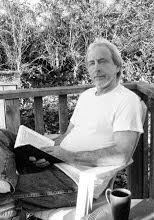
As far as I know, Mike doesn't spend a lot of time under a banyan tree. But having spent some time with his video-poems, I end up in something like a Zen frame of soul. More about those poems later.
Mike is a professional writer. That means he actually gets paid real money for writing stuff. That blows my mind. Many people manage to publish stuff. Most never see a dime. Of course, getting paid for stuff doesn't always indicate the writing is good. And I'm sure there's a lot of good stuff that never gets published. But in general, it means a real, professional editor has passed an approving verdict. It means that Mike's writings have weathered a somewhat objective filter.
He's been writing a long time. He's learned a few things about prose and poetry. When he offers a critique on my stuff, I take it seriously and most times acquiesce in his judgement. But since he's not too fond of overcooked romantic waywardness, I don't usually tag him with my writings. It's not that I don't wish to be bluntly dealt with; rather, I just don't want to irritate or bore him with my highly non-Zen effusions. And by "Zen," I mean approaching things clearly, without obfuscation, without Tchaikovskian cadence, and free of addled emotionalism. But if you think you write clear and penetrating poetry, do tag him -- you'll get his honest, worthy, and blunt opinion.
Mike is realistic about poetry. He writes poems, but he knows that for humanity, in general, poetry is beside the point. For every person who adores poetry, ten-thousand others could not care less. And he knows that most poetry sucks big time. Very few people are gonna get rich publishing poems. You pretty much need to win a Nobel Prize. But he still writes poems. For himself and us few for whom poetry is an old vessel that sometimes holds exquisite drops of reality. Great music and great painting reach us in the deep places. Occasionally, a poem does, too.
When I made friends with Mike on Facebook over a year ago, I began reading some memoir pieces he posted. They are wonderful. Not only are they written with talent, they are well-crafted and disciplined. And funny as hell. For days, weeks, I read and chuckled. Sometimes snorted and guffawed. The humor is so wry and subtle that it creeps up on you, hence eliciting little explosions of mirth.
Mike has had a very tough year. His beloved daughter Daniele committed suicide. If you are already mutual friends with Mike, you know what happened and why. If not, please send him a friend request. On his page, you'll learn the details. You'll learn about how this tragedy came about and how its aftereffect has influenced Mike's spiritual journey. How it has led to his creating support groups and supporting others. How it has charged reminiscence with poignant beauty, and poems with an austere hope.
Now...I want to talk about Mike's video-poems. About why I call him a "buddha." I selected one of those video-poems to illustrate what I'm getting at:
Water Hills
Water Hills YouTube
The images and the music complementing Mike's words speaks for itself. And only brief mention needs to be made about his very good reading ability. It's the words. Well...no, that's not right. These things are made as complexes -- images, music, voice, and words all working together. So how can I justify extracting only the words? I can't, really. But those words! They somehow manage to be as direct as ice, yet also as elusive as a koan. They make me feel a certain way. They banish time. Or allow me to fall into a different version of time -- Zen-time. I feel I'm riding a slow Ferris wheel and that my soul is curving around Mike's poem, around his words. Each line forms a spoke radiating from a dark or ambiguous hub of deep-breathed reality. Mike is a good poet: these lines -- these spokes -- could have been made too fragile with too many abstractions, but he strengthens them with images that are perfectly judged. This is a kind of beauty with weight and spiritual significance.
Mike Finley -- the blunt buddha of Minnesota. Sometimes, this buddha is argumentative...or maybe it's that he likes to slip around the curve of your thought. To always give you a fresh perspective on a topic. Or maybe there's a bit of curmudgeon in this northern swami. But back to writing -- once, he complimented me on the title of one of my prose ramblings. That kind of thing makes an impression.
Okay, the end, almost. One last thing, a repetition: Mike gets paid real money for writing. That is an astonishing accomplishment in life. He has my respect and appreciation.
Oh...one even more-last last thing. Mike Finley is a very warm-hearted blunt buddha.
Thursday, November 4, 2010

Sunday, October 17, 2010
Lisa Alvarado and a poem
One of the odd things about writing is that when you wish to talk about certain topics you first have to talk about yourself – what you know or don't know, the shape and extent of your sensibility, why you might be worth listening to. Context must be conveyed.
I know when a poem comes from a place of magic and beauty. I don't know how that could possibly happen. The shape of my sensibility is spiral, its extent is mapped in irrational space. I am worth listening to because I am inviting you to a celebration – to an appreciation of Lisa Alvarado's poem “Garden, dark.”
Lisa is a rare one. She seems fiercely ethical, compassionate, and honest. Lisa is a paradoxical one. She seems as gentle as a hovering tear, as a sigh of wind through leaves or across a landscape of symbolic longing. But it's not really a paradox at all. I think the word “passionate” holds all aspects quite nicely.
Lisa is Chicana and Jewish. Both of those worlds (or that manifold one world) are fairly unknown to me. Of course, like many people who read a lot of stuff, I have some touchstones. And my imagination steps spryly across them. To bridge many cultural gaps.
When I think of the word “Chicana,” images flow: zoot suits, Steinbeck characters and settings, the United Farm Worker movement, American border paranoia, Los Lobos. I think of colors and rhythms and struggles. When I think of the word “Jewish,” in its Sephardi connection, the picture emerges of a Spain draped in roses, romance, and religion. A Spain both enjoying the aesthetic contributions of Jews while also looking arrogantly askance at that ethnic minority...and then expulsion to far-flung places...even to Mexico.
The cool thing about poetry is that it reveals implicitly how the human spirit is kindred, across cultural, even language barriers. Hearts push blood similarly colored in feelings, desires, visions. We are one vast and crazy tribe of beings. Love binds us together. Consider Lisa's poem:
Garden, dark
At midnight, wildflower,
(Yes, that is your true name)
before that blank page of sleep overtook me,
I saw you clearly --a free spirit
blossoming outside what I call garden,
rare, color-ripe,
but destined to be forever and irretrievably another's.
Because the wild flowers inside you,
I dream your eyes bloom at the shabbos tish,
and I feel awe washing over me --
the breath of lost angels and lost family.
A prayer flowering inside you, despite you.
In the place where winds brawl, rain shatters,
and driven wild, flowers fly in all directions.
The world is dark, and time crashes down.
Covered by the flexed hands of night,
bathed in spilled moonlight,
do you sense me near?
I want those wildflowers to appear once more
to dance you to me in another dream.
There, far away from chaos within and without,
a Beit Shemesh wind whispers faint clues
to weave us with life's essential and aching joy.
Searching for warm breath and salvation,
I hope you find some with me, where the wild flowers.
Copyright 2010, Lisa Alvarado
This poem is a non-didactic demonstration of the power of language. Of how lines might move with a Euclidean perfection, yet are not measured with a conscious ruler. The prosody is an innate possession of the poet. Or maybe it expresses the pulse of experience and the pace of deep feeling through life. Such is the first magic.
Then come the images. For me, the best poetry subsumes abstraction and confession beneath the sufficiency of images. Pictures bloom in the mind, and they are alive with connotation and allusion. Just like in this poem.
blossoming outside what I call garden,
rare, color-ripe,
Everything depends on “what I call garden”. With that phrase, the poem expands into a sphere, like a snow-globe. Instead of snowflakes cascading, this garden-sphere is filled with atoms of suspense, pieces of dream. An unseen profusion of roots, stalks, blooms, and aromas of desiring. And “rare, color-ripe,” lets us know this “garden” is in a very serious stage of growth.
and I feel awe washing over me --
the breath of lost angels and lost family.
This love is not cheap, lascivious, neurotic. Lisa's words convey that special mood of being when the beloved fills the soul's sphere. Yes, “awe.” One has glimpsed behind the mask of nature. One has peered into the sublimity of a beloved. Into an eternal moment of blessedness. Even if the emotion is unrequited, even if one might never reach into the curving surface of the sphere, one loves unconditionally. Then, “the breath of lost angels and lost family”. That's exactly it. That just how deep one goes into such an ideal love. The ennui is not inertial. A pendulum of regard traces out a continuous pattern, mapping a zone both transcendent and rooted.
In the place where winds brawl, rain shatters,
and driven wild, flowers fly in all directions.
Unconditional love does not necessarily mean calm love. The sphere – the garden zone of regard – is occasionally roiled with raw passion at the edge of chaos. In the wonderful agony, one wails unheard beneath the storm of tears and colors.
“The world is dark....”
What fool would attempt to say anything about this stanza? Any touching of it with cloying words would be a sacrilege. Except to say, indeed, the sphere is dark.
to weave us with life's essential and aching joy.
Searching for warm breath and salvation,
I hope you find some with me, where the wild flowers.
One is left with a vague hope. One hopes that all forms, processes, and energies of being will resolve themselves eventually into a blending of souls. Eternity is in those lines -- a long-sustained sadness ripening toward some far glory. Of being truly known by another.
An informed person would know what “shabbos tish” and “Beit Shemesh” mean. An uninformed person who is sensible would look them up. Not me. I'm neither informed nor sensible. I am irrational. Hence, those terms are springboards for my imagination, for a delicious floating off into ambiguity. They work for me as the exotic haze surrounding some possible but unseen planet. They have an undiagnosed resonance of mystery, of old history for me. Of a cultural penumbra that stimulates me because it is unknown.
Well...to conclude, I'll simply say that I hope this poem finds its way into an anthology of quality work. That it will succor and beautifully perplex readers one hundred years from now.
Lisa's web page
I know when a poem comes from a place of magic and beauty. I don't know how that could possibly happen. The shape of my sensibility is spiral, its extent is mapped in irrational space. I am worth listening to because I am inviting you to a celebration – to an appreciation of Lisa Alvarado's poem “Garden, dark.”
Lisa is a rare one. She seems fiercely ethical, compassionate, and honest. Lisa is a paradoxical one. She seems as gentle as a hovering tear, as a sigh of wind through leaves or across a landscape of symbolic longing. But it's not really a paradox at all. I think the word “passionate” holds all aspects quite nicely.
Lisa is Chicana and Jewish. Both of those worlds (or that manifold one world) are fairly unknown to me. Of course, like many people who read a lot of stuff, I have some touchstones. And my imagination steps spryly across them. To bridge many cultural gaps.
When I think of the word “Chicana,” images flow: zoot suits, Steinbeck characters and settings, the United Farm Worker movement, American border paranoia, Los Lobos. I think of colors and rhythms and struggles. When I think of the word “Jewish,” in its Sephardi connection, the picture emerges of a Spain draped in roses, romance, and religion. A Spain both enjoying the aesthetic contributions of Jews while also looking arrogantly askance at that ethnic minority...and then expulsion to far-flung places...even to Mexico.
The cool thing about poetry is that it reveals implicitly how the human spirit is kindred, across cultural, even language barriers. Hearts push blood similarly colored in feelings, desires, visions. We are one vast and crazy tribe of beings. Love binds us together. Consider Lisa's poem:
Garden, dark
At midnight, wildflower,
(Yes, that is your true name)
before that blank page of sleep overtook me,
I saw you clearly --a free spirit
blossoming outside what I call garden,
rare, color-ripe,
but destined to be forever and irretrievably another's.
Because the wild flowers inside you,
I dream your eyes bloom at the shabbos tish,
and I feel awe washing over me --
the breath of lost angels and lost family.
A prayer flowering inside you, despite you.
In the place where winds brawl, rain shatters,
and driven wild, flowers fly in all directions.
The world is dark, and time crashes down.
Covered by the flexed hands of night,
bathed in spilled moonlight,
do you sense me near?
I want those wildflowers to appear once more
to dance you to me in another dream.
There, far away from chaos within and without,
a Beit Shemesh wind whispers faint clues
to weave us with life's essential and aching joy.
Searching for warm breath and salvation,
I hope you find some with me, where the wild flowers.
Copyright 2010, Lisa Alvarado
This poem is a non-didactic demonstration of the power of language. Of how lines might move with a Euclidean perfection, yet are not measured with a conscious ruler. The prosody is an innate possession of the poet. Or maybe it expresses the pulse of experience and the pace of deep feeling through life. Such is the first magic.
Then come the images. For me, the best poetry subsumes abstraction and confession beneath the sufficiency of images. Pictures bloom in the mind, and they are alive with connotation and allusion. Just like in this poem.
blossoming outside what I call garden,
rare, color-ripe,
Everything depends on “what I call garden”. With that phrase, the poem expands into a sphere, like a snow-globe. Instead of snowflakes cascading, this garden-sphere is filled with atoms of suspense, pieces of dream. An unseen profusion of roots, stalks, blooms, and aromas of desiring. And “rare, color-ripe,” lets us know this “garden” is in a very serious stage of growth.
and I feel awe washing over me --
the breath of lost angels and lost family.
This love is not cheap, lascivious, neurotic. Lisa's words convey that special mood of being when the beloved fills the soul's sphere. Yes, “awe.” One has glimpsed behind the mask of nature. One has peered into the sublimity of a beloved. Into an eternal moment of blessedness. Even if the emotion is unrequited, even if one might never reach into the curving surface of the sphere, one loves unconditionally. Then, “the breath of lost angels and lost family”. That's exactly it. That just how deep one goes into such an ideal love. The ennui is not inertial. A pendulum of regard traces out a continuous pattern, mapping a zone both transcendent and rooted.
In the place where winds brawl, rain shatters,
and driven wild, flowers fly in all directions.
Unconditional love does not necessarily mean calm love. The sphere – the garden zone of regard – is occasionally roiled with raw passion at the edge of chaos. In the wonderful agony, one wails unheard beneath the storm of tears and colors.
“The world is dark....”
What fool would attempt to say anything about this stanza? Any touching of it with cloying words would be a sacrilege. Except to say, indeed, the sphere is dark.
to weave us with life's essential and aching joy.
Searching for warm breath and salvation,
I hope you find some with me, where the wild flowers.
One is left with a vague hope. One hopes that all forms, processes, and energies of being will resolve themselves eventually into a blending of souls. Eternity is in those lines -- a long-sustained sadness ripening toward some far glory. Of being truly known by another.
An informed person would know what “shabbos tish” and “Beit Shemesh” mean. An uninformed person who is sensible would look them up. Not me. I'm neither informed nor sensible. I am irrational. Hence, those terms are springboards for my imagination, for a delicious floating off into ambiguity. They work for me as the exotic haze surrounding some possible but unseen planet. They have an undiagnosed resonance of mystery, of old history for me. Of a cultural penumbra that stimulates me because it is unknown.
Well...to conclude, I'll simply say that I hope this poem finds its way into an anthology of quality work. That it will succor and beautifully perplex readers one hundred years from now.
Lisa's web page
Friday, October 1, 2010
Isaac Stern almost drove me crazy
Seventeen years ago, I bought a cassette tape of Brahms's Violin Concerto. Isaac Stern on violin, with Ormandy conducting the Philadelphia.
It nearly drove me nuts. Stern's scratchy, desperate playing sounded like something issuing from the depths of an insane asylum. I was mesmerized. Could not stop listening. Maybe it was the beauty of the orchestra around the soloist, or maybe it was the innate marvelousness of Brahms's creation -- something kept me listening to this over and over and over.
Mr. Stern was not a bad violinist. I knew that. I had heard wonderful stuff from him in chamber pieces. This was such a puzzle. Had Brahms actually written such impossible notes for the soloist? Stern's playing did not seem to me an artistic expression. It struck me as the string-shrieking, ear-wincing output of someone who had picked up the violin for the first time. And struggling through the score as best they could.
What the hell?
So imagine my epiphany a couple years later. When I heard Heifetz's recording with the Chicago Symphony under Reiner! Heifetz, the master tonalist, does not saw the score into note-shreds. Each difficult double-stop and transition is handled with such aplomb that the concerto seems almost a different composition.
Looking back, I am grateful to Mr Stern. His playing in that work riveted me to the spot. I could not let it go. I had to figure out some way of making sense of what I was hearing. Through those long wincing sessions, the latent spirit of Brahms's miraculous concerto worked its way deep into the cracks of my brain.
It nearly drove me nuts. Stern's scratchy, desperate playing sounded like something issuing from the depths of an insane asylum. I was mesmerized. Could not stop listening. Maybe it was the beauty of the orchestra around the soloist, or maybe it was the innate marvelousness of Brahms's creation -- something kept me listening to this over and over and over.
Mr. Stern was not a bad violinist. I knew that. I had heard wonderful stuff from him in chamber pieces. This was such a puzzle. Had Brahms actually written such impossible notes for the soloist? Stern's playing did not seem to me an artistic expression. It struck me as the string-shrieking, ear-wincing output of someone who had picked up the violin for the first time. And struggling through the score as best they could.
What the hell?
So imagine my epiphany a couple years later. When I heard Heifetz's recording with the Chicago Symphony under Reiner! Heifetz, the master tonalist, does not saw the score into note-shreds. Each difficult double-stop and transition is handled with such aplomb that the concerto seems almost a different composition.
Looking back, I am grateful to Mr Stern. His playing in that work riveted me to the spot. I could not let it go. I had to figure out some way of making sense of what I was hearing. Through those long wincing sessions, the latent spirit of Brahms's miraculous concerto worked its way deep into the cracks of my brain.
Thursday, September 30, 2010
William Crawford: soul-snatcher
I woke up this morning thinking about the poetry of William Crawford. When I think about something, I usually want to write about it. Lately I've learned, more or less, to resist that peculiar personal quirk. Or let's say I've begun to actually ask myself beforehand: why are you about to start typing? Is it a mere flush of exuberance, a goofy way to say, “I exist, because I experienced something, and others must be informed of my existence and what I just experienced”? Or have I gathered a solid impression and allowed that experience to properly ferment...to the point that something worth saying has emerged? Who knows? And how come this piece on the poetry of William Crawford has so quickly turned into words about me?
I woke up this morning thinking about one of Will's recent poems – “Beguilement (or what Klaus said to the Butterfly)”. And I'm wondering how Will got to be himself. How does the world make a mind like his? More on that poem later. For now, I want to amble through my head and ponder the fact that Will's mind got made this certain way. I wonder if the distribution of enhanced consciousness among humans is a zero-sum game: some got it 'cause others ain't. Not enough of that stuff floating around for everyone to have it. If we all had minds like Will, there would probably be a cosmic consequence. The back-end of the universe would most likely collapse into a big sucking void. So...there you have it. Certain sensibilities are rare, so the World doesn't suck itself out. And the even rarer combination of sensibility and talent means Earth is not going to be an aesthetically democratic joint. To make one Will Crawford means there must be one million mundane zombies in the off-set.
Will likes the films of Werner Herzog. That pretty much says it all for me. He also likes a lot of cool music, stuff that is mostly beyond my ken. Deep blues somehow makes me feel weird. Makes me want to wrap myself, like a Terry Gilliam character, in plastic and foil to keep the intensity of that stuff at a harmless remove. So I haven't plumbed those depths to the extent that Will has.
I don't really know that much about Will. What his favorite books are. What kind of dreams he has at night. When he laughs, does he chortle or guffaw? Nonetheless, I feel a kindred something with him when I read his poems. (Oh...so it's back to me, now, is it? If this keeps up, I'll soon start maundering about a ghostly moon humming its languid lullaby to my broken heart...or something.) I wish I could find one word to describe the Crawford essence. That would simplify things for me. One word to encompass that intelligence and moxie and flair and soul-depth that his poems exude. There's probably a good word for all that in Russian. I'll just imagine there is – something with a bunch of “o”s and “v”s. It probably starts with an “s”.
One of the intensest pleasures of reading poetry is when a poem stimulates a sympathetic vibration in your soul. Some image or feeling or thought that is new for you yet seems familiar, or is something that is latent in your own sensibility. A kind of slow whiplash occurs. Some quantum theory guys and gals say that each moment splits off into infinite worlds of possibilities unrealized in this one. That's pretty far out. But maybe that déjà vu-lag we experience in certain poems is the back-flow from our possible lives. That sense of “Aha,” based on no known history, is a signal pinging in the meta-schizophrenia of our far-flung quarky selves.
I really don't know that much about Will, but some of his poems seem to know something about me.
And his poems, in general, seem to know a great deal about human experience, about the faintest registrations of being and psychological stress. Of how things fall into arrays of significance for a wide cast of characters. Yes, that's it! Will's poems are uncanny penetrations into the hearts and minds of others. He is a sensitive observer. Empathy is his orientation. And those poems have a profound ramification: they make a reader aware of the infinite strangeness and fragility and strength and beauty of persons -- some regular, some eccentric. In short, Will takes these characters over, inhabits them for a while, snatches their souls long enough to put pieces of them down on the page for us.
Reading a Will Crawford poem, you will not be subjected to an unbridled ego bellowing forlornly at the moon. Will himself is only implicit in these poems. He is in the talent and empathy and sympathy of the lines, not in the declamations of a first-person woebegoner.
Let's look at one of his poems.
Beguilement (or what Klaus said to the Butterfly)
at first
you were
a sweet irritation
to me,
butterfly
filament thin wings
their papery sound
a flutter of
almost fleshy
nothingness
drawn to me
as tongue is
to bad tooth
why are you
so unafraid?
is it the wind
that makes you shiver
like this,
or just the
shock of contact,
butterfly?
so many have seen
this net of darkness
pouring from my eyes
in torrent, in tear,
collecting in
reflective pools
pregnant and still
so few
have delved
below
the surface
investigated the
enlarged heart,
lent an ear to
the simple song
that beats beneath –
a restless rhythm
of survival
pain
in bubbles
rising
only to burst
what have you seen,
what have you heard,
butterfly?
can it be
my eyes –
sometimes twin tyrants raging,
other times tapped hydrants
freely flowing
a confluence of summer colors:
cooling children
leaping, and loping,
laughing through
sudden rainbow,
softly shot –
have these old tired eyes
become a light source
for you,
only you,
butterfly?
have you sent your
milky infant eyes
with all their warmth
past this mask I wear,
this flash frozen façade,
to a place where
the ice is
finally melting
in seismic drip?
am I both flower,
and flame,
to you,
butterfly?
my throbbing palm,
closed in an instant,
could disrupt
your graceful arc,
endanger your
empyreal (f)light,
with the weighted crush
of calculated impact,
butterfly
a final metamorphosis,
or maybe
just a
dreamless sleep
awaits with
a killing stillness
an unbending end
to this
beguilement
the easy music
and sweetly
confusing amusement
we now share
here where the light
is soft and strong
does it not
seem brighter now,
butterfly?
prismatic wings
unfolding smile
this odd gentling
this curious metamorphosis
I feel my blood
turning into ballet
I am a child again.
Copyright © 2010 William Crawford
 "I knew there were, in myself, the souls of millions of people who lived centuries ago; not just people but animals, plants, the elements, things, even, matter. All of these exist in me."
-Klaus Kinski
Well...I intended to write a bunch of stuff about this poem. About what it does for me, what it means for me. Maybe even probe how it is that this poem is what it is. How the images and subtle conveyance of a soul light up inside my head. But that would just be a wheelbarrow full of word-junk. This poem speaks plainly and marvelously for itself.
Poet Connie Stadler suggested Will to me as a Facebook friend. I am very beholding to her.
I woke up this morning thinking about one of Will's recent poems – “Beguilement (or what Klaus said to the Butterfly)”. And I'm wondering how Will got to be himself. How does the world make a mind like his? More on that poem later. For now, I want to amble through my head and ponder the fact that Will's mind got made this certain way. I wonder if the distribution of enhanced consciousness among humans is a zero-sum game: some got it 'cause others ain't. Not enough of that stuff floating around for everyone to have it. If we all had minds like Will, there would probably be a cosmic consequence. The back-end of the universe would most likely collapse into a big sucking void. So...there you have it. Certain sensibilities are rare, so the World doesn't suck itself out. And the even rarer combination of sensibility and talent means Earth is not going to be an aesthetically democratic joint. To make one Will Crawford means there must be one million mundane zombies in the off-set.
Will likes the films of Werner Herzog. That pretty much says it all for me. He also likes a lot of cool music, stuff that is mostly beyond my ken. Deep blues somehow makes me feel weird. Makes me want to wrap myself, like a Terry Gilliam character, in plastic and foil to keep the intensity of that stuff at a harmless remove. So I haven't plumbed those depths to the extent that Will has.
I don't really know that much about Will. What his favorite books are. What kind of dreams he has at night. When he laughs, does he chortle or guffaw? Nonetheless, I feel a kindred something with him when I read his poems. (Oh...so it's back to me, now, is it? If this keeps up, I'll soon start maundering about a ghostly moon humming its languid lullaby to my broken heart...or something.) I wish I could find one word to describe the Crawford essence. That would simplify things for me. One word to encompass that intelligence and moxie and flair and soul-depth that his poems exude. There's probably a good word for all that in Russian. I'll just imagine there is – something with a bunch of “o”s and “v”s. It probably starts with an “s”.
One of the intensest pleasures of reading poetry is when a poem stimulates a sympathetic vibration in your soul. Some image or feeling or thought that is new for you yet seems familiar, or is something that is latent in your own sensibility. A kind of slow whiplash occurs. Some quantum theory guys and gals say that each moment splits off into infinite worlds of possibilities unrealized in this one. That's pretty far out. But maybe that déjà vu-lag we experience in certain poems is the back-flow from our possible lives. That sense of “Aha,” based on no known history, is a signal pinging in the meta-schizophrenia of our far-flung quarky selves.
I really don't know that much about Will, but some of his poems seem to know something about me.
And his poems, in general, seem to know a great deal about human experience, about the faintest registrations of being and psychological stress. Of how things fall into arrays of significance for a wide cast of characters. Yes, that's it! Will's poems are uncanny penetrations into the hearts and minds of others. He is a sensitive observer. Empathy is his orientation. And those poems have a profound ramification: they make a reader aware of the infinite strangeness and fragility and strength and beauty of persons -- some regular, some eccentric. In short, Will takes these characters over, inhabits them for a while, snatches their souls long enough to put pieces of them down on the page for us.
Reading a Will Crawford poem, you will not be subjected to an unbridled ego bellowing forlornly at the moon. Will himself is only implicit in these poems. He is in the talent and empathy and sympathy of the lines, not in the declamations of a first-person woebegoner.
Let's look at one of his poems.
Beguilement (or what Klaus said to the Butterfly)
at first
you were
a sweet irritation
to me,
butterfly
filament thin wings
their papery sound
a flutter of
almost fleshy
nothingness
drawn to me
as tongue is
to bad tooth
why are you
so unafraid?
is it the wind
that makes you shiver
like this,
or just the
shock of contact,
butterfly?
so many have seen
this net of darkness
pouring from my eyes
in torrent, in tear,
collecting in
reflective pools
pregnant and still
so few
have delved
below
the surface
investigated the
enlarged heart,
lent an ear to
the simple song
that beats beneath –
a restless rhythm
of survival
pain
in bubbles
rising
only to burst
what have you seen,
what have you heard,
butterfly?
can it be
my eyes –
sometimes twin tyrants raging,
other times tapped hydrants
freely flowing
a confluence of summer colors:
cooling children
leaping, and loping,
laughing through
sudden rainbow,
softly shot –
have these old tired eyes
become a light source
for you,
only you,
butterfly?
have you sent your
milky infant eyes
with all their warmth
past this mask I wear,
this flash frozen façade,
to a place where
the ice is
finally melting
in seismic drip?
am I both flower,
and flame,
to you,
butterfly?
my throbbing palm,
closed in an instant,
could disrupt
your graceful arc,
endanger your
empyreal (f)light,
with the weighted crush
of calculated impact,
butterfly
a final metamorphosis,
or maybe
just a
dreamless sleep
awaits with
a killing stillness
an unbending end
to this
beguilement
the easy music
and sweetly
confusing amusement
we now share
here where the light
is soft and strong
does it not
seem brighter now,
butterfly?
prismatic wings
unfolding smile
this odd gentling
this curious metamorphosis
I feel my blood
turning into ballet
I am a child again.
Copyright © 2010 William Crawford
 "I knew there were, in myself, the souls of millions of people who lived centuries ago; not just people but animals, plants, the elements, things, even, matter. All of these exist in me."
-Klaus Kinski
Well...I intended to write a bunch of stuff about this poem. About what it does for me, what it means for me. Maybe even probe how it is that this poem is what it is. How the images and subtle conveyance of a soul light up inside my head. But that would just be a wheelbarrow full of word-junk. This poem speaks plainly and marvelously for itself.
Poet Connie Stadler suggested Will to me as a Facebook friend. I am very beholding to her.
Saturday, September 25, 2010

Thursday, September 23, 2010
cages
Some fellows type words for lines for a poem,
wishing to express themselves in a special manner.
They have something to say about something or other.
They want to share what's in their minds, their souls.
And then there is the fellow who tries to make a poem
into a little world. A special atom to contain someone.
As days and nights fail, the big world is shadowed over.
He will go into words. He will grasp at spells of words
that tremble in the spaces where memories never formed.
He will let them flow wildly, more dream than meaning...
“In that scented field of mown barley
where blackbirds skitter through dull sky
and the way it must feel is brushstrokes
gone mad with dark Dutch colors!...
There! I will surely meet you there,
at dusk when this air begins to chill
and your untouched hand is warm.”
That strange fellow will live for a day, maybe into one night
inside each little world he has made with words into a poem.
Until he discovers with a sort of shock that his words
have become cages of dead time and very empty space.
He sits blinking, looking out at what has been cordoned.
He almost smiles at how gradually he became a prisoner.
Our fellow wonders if she read them.
Our fellow is glad she probably didn't.
Or maybe he's sad.
Whatever.
He shrugs a shrug of resignation.
Fires up an existential cigarette.
It's high time to use the key
of hard will to break dreams.
And if that key breaks off, pour
Leonard Cohen into the lock...
The best way out of captivity
is to swim in the ridiculous pain.
wishing to express themselves in a special manner.
They have something to say about something or other.
They want to share what's in their minds, their souls.
And then there is the fellow who tries to make a poem
into a little world. A special atom to contain someone.
As days and nights fail, the big world is shadowed over.
He will go into words. He will grasp at spells of words
that tremble in the spaces where memories never formed.
He will let them flow wildly, more dream than meaning...
“In that scented field of mown barley
where blackbirds skitter through dull sky
and the way it must feel is brushstrokes
gone mad with dark Dutch colors!...
There! I will surely meet you there,
at dusk when this air begins to chill
and your untouched hand is warm.”
That strange fellow will live for a day, maybe into one night
inside each little world he has made with words into a poem.
Until he discovers with a sort of shock that his words
have become cages of dead time and very empty space.
He sits blinking, looking out at what has been cordoned.
He almost smiles at how gradually he became a prisoner.
Our fellow wonders if she read them.
Our fellow is glad she probably didn't.
Or maybe he's sad.
Whatever.
He shrugs a shrug of resignation.
Fires up an existential cigarette.
It's high time to use the key
of hard will to break dreams.
And if that key breaks off, pour
Leonard Cohen into the lock...
The best way out of captivity
is to swim in the ridiculous pain.
Thursday, September 16, 2010
Fugitive Visions (my homemade "chapbook")
I put together a PDF “chapbook” of some of my poems. It's available as a free download here:

Subscribe to:
Posts (Atom)